[Click here to watch the video report]
THE BIONDI VALIDATION
ArchaeoSAR Program Report, By Trevor Grassi, November 11, 2026
This exclusive report reveals the very first successful, independent, 3rd party replication of Dr. Filippo Biondi’s SAR subsurface scanning method. Independent researcher and author of Under the Sphinx, Dr. Manu Seyfzadeh, has reverse engineered the technique by studying Biondi’s public papers and filling in the gaps (left by aspects that remain proprietary), through trial and error. With no affiliation to (or inside information from) Filippo, HarmonicSAR or the Khafre Research Project, he has independently verified both the process itself, and several of the scan results obtained at Giza.
Contents / Quick Links
Introduction
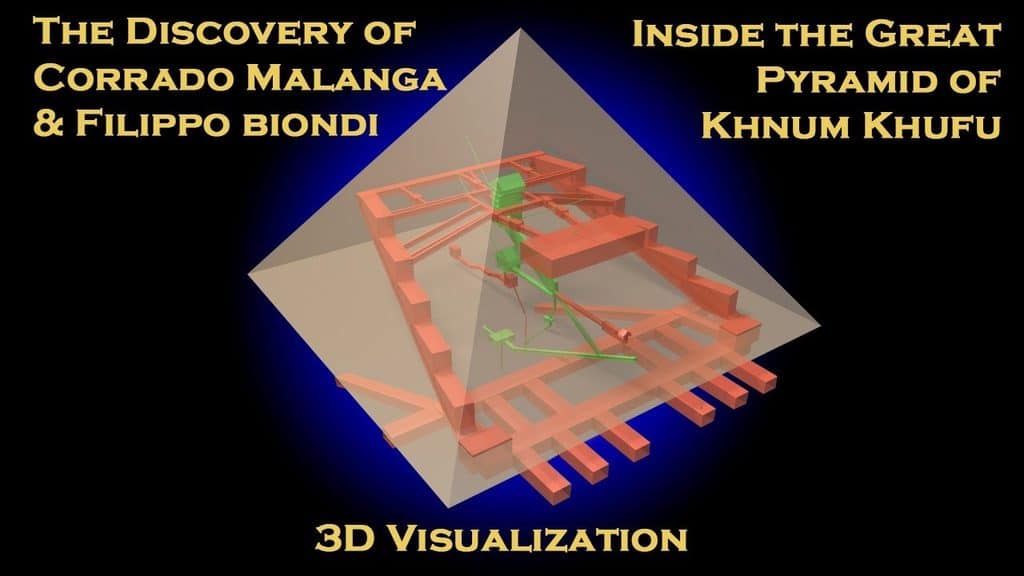
After the release of Biondi’s 2022 paper, co-authored by Dr. Corrado Malanga, and especially after the team’s 2025 discoveries beneath the Khafre Pyramid, a global debate ensued. The new technology that Filippo presented was challenged, mocked and called impossible by various influencers in the public arena, despite the many proofs of the method presented. They presented scans of known structures like the Osiris Shaft, the North Face Corridor of the Great Pyramid, and the 1,400 meter deep Gran Sasso Physics Laboratory in Italy; in every case, demonstrating the ability to portray the structure accurately.
While many skeptics boldly proclaimed fraud, not a single one of them had even the vaguest concept of the technology itself, and from the roughly 200 actual SAR experts on Earth, not a single critique was heard.
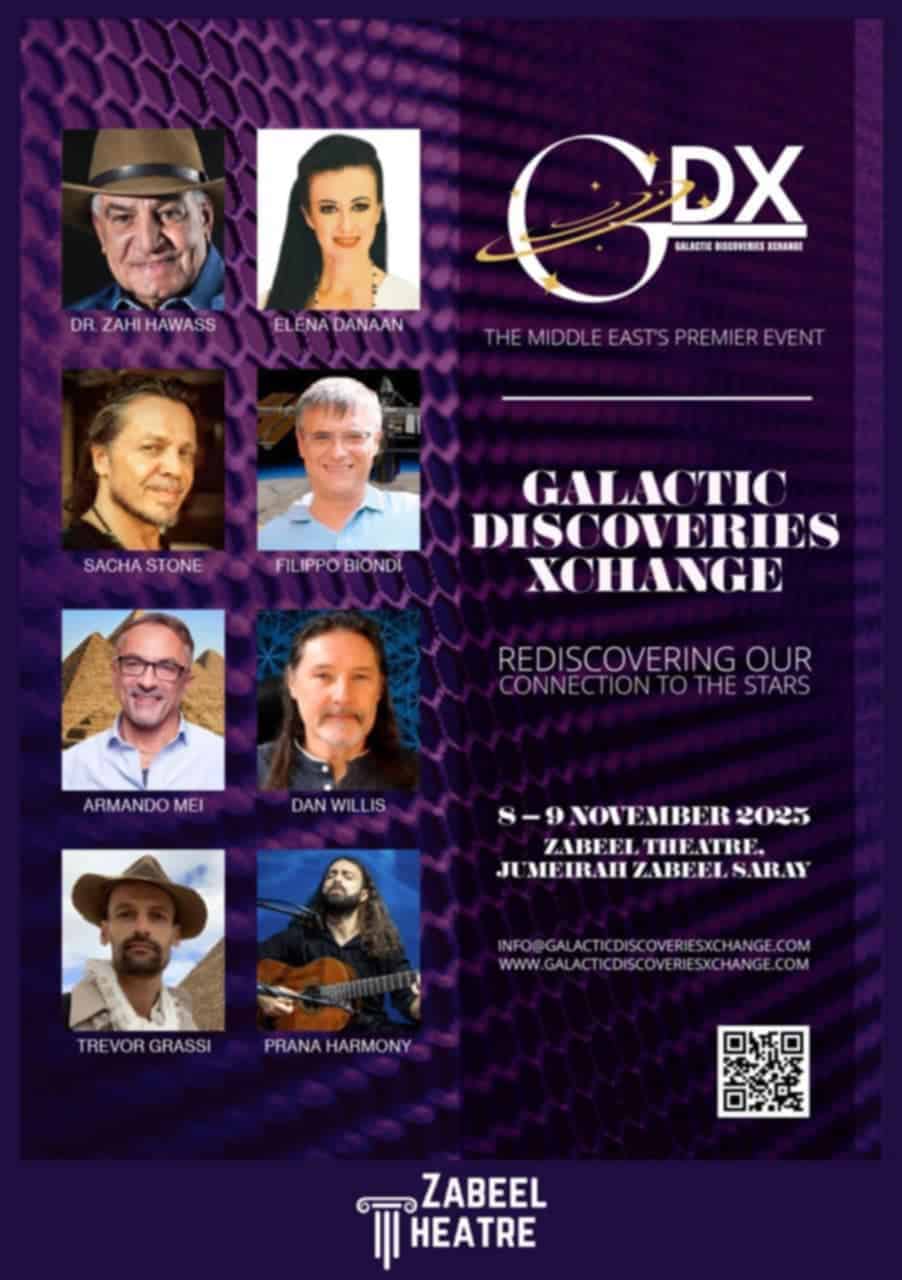
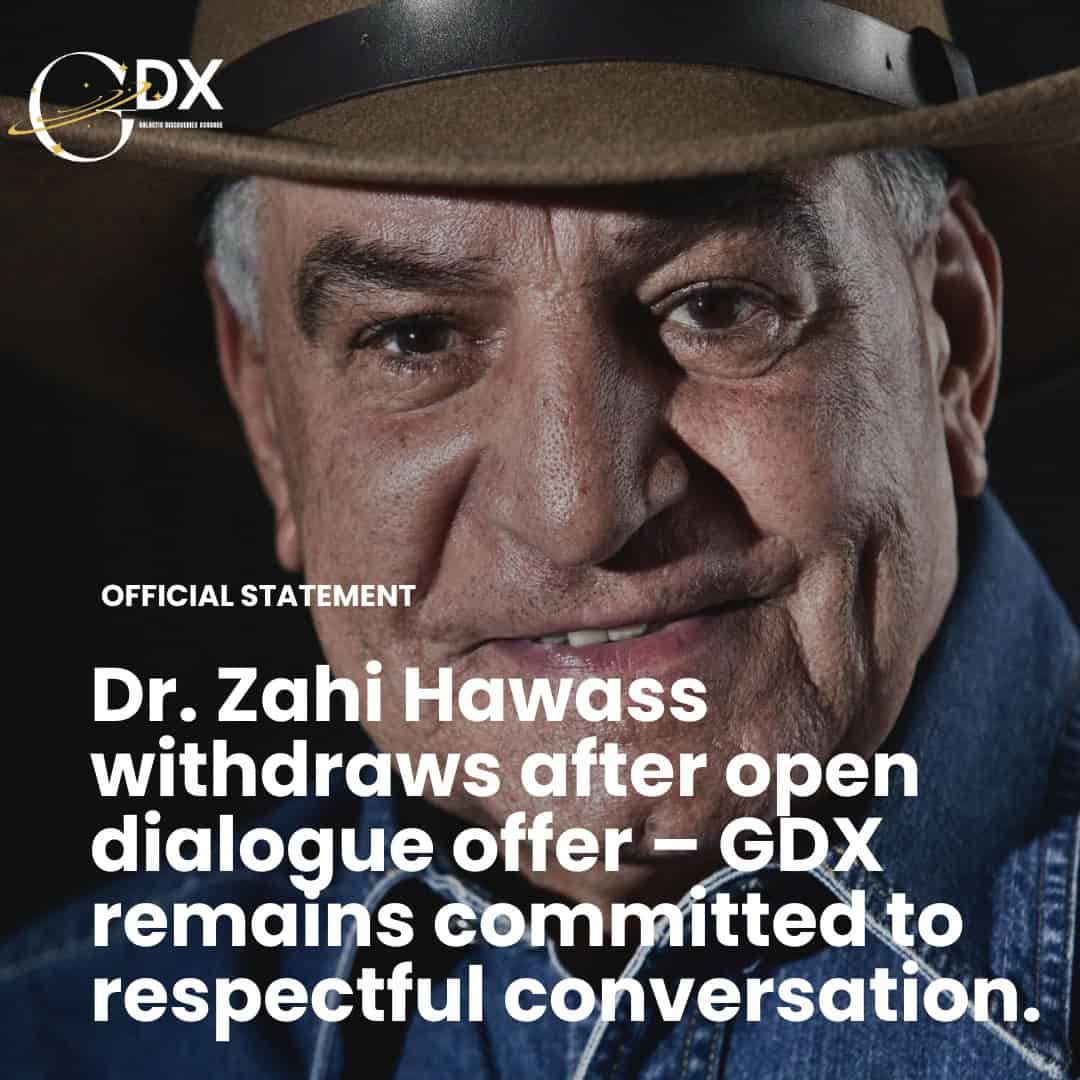
Dr. Zahi Hawass himself, representing the Egyptian authorities, offered only a rude, completely uninformed, slanderous attack on the discoveries. Later, on the Joe Rogan Experience, he lied about his willingness to hold dialogue with Filippo. He stated that he would “of course” be willing to speak with the team, and yet only months later, he specifically dropped out of a conference that he was scheduled to speak at, when he realized that Filippo, Armando Mei, and I were also scheduled to speak, and that we wanted very much to have respectful dialogue with him.
The Retraction:
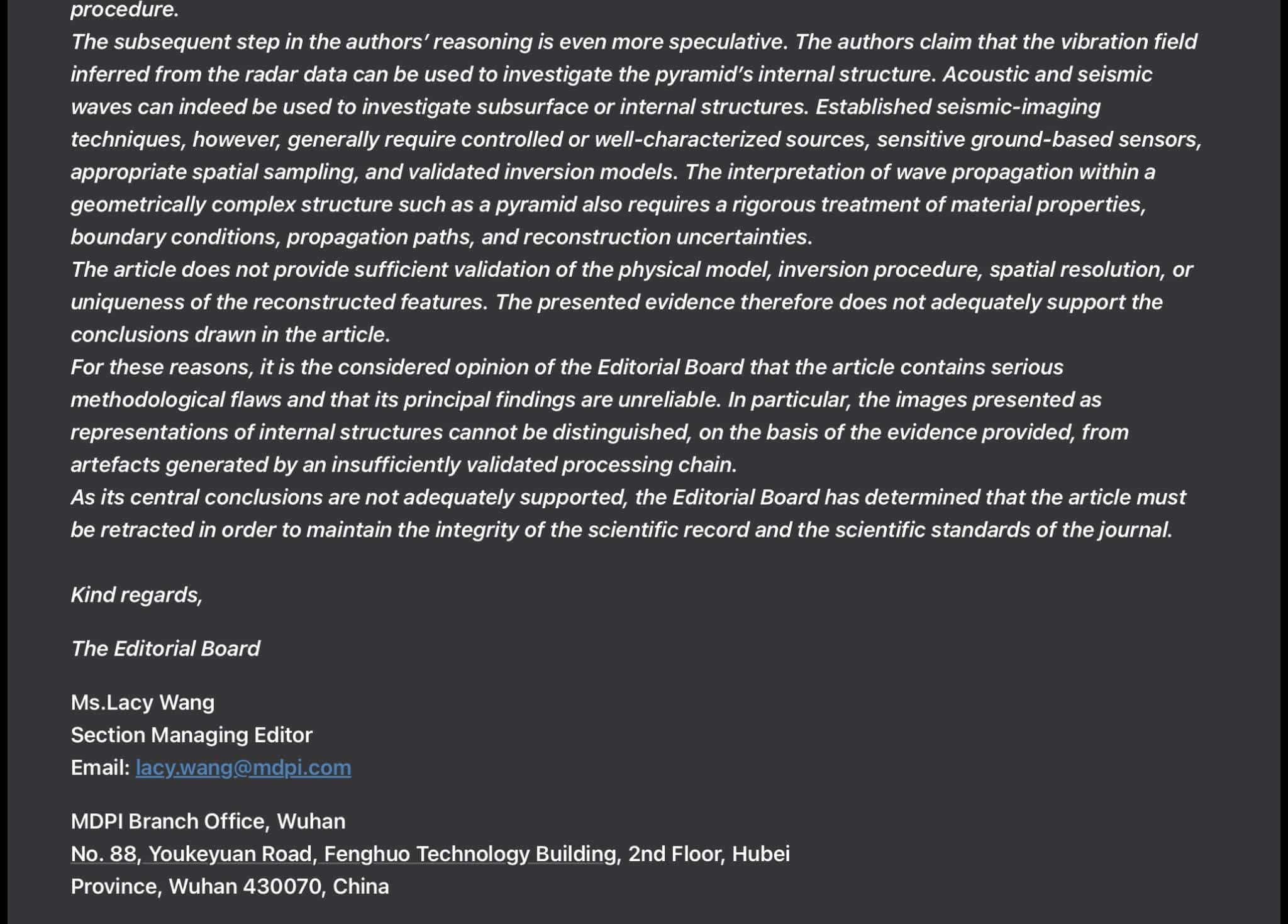
In 2026, the unfair treatment of Filippo’s research intensified, as the 2022 paper was suddenly retracted by the MDPI Remote Sensing journal. The journal provided no substantial reasoning for the retraction whatsoever, citing only unspecified “serious methodological flaws and statistical errors”. This is a very serious, defamatory accusation to make against professionals in the field, and given that not a shred of evidence was provided to back the claim, it is truly unthinkable, and directly opposed to every true scientific principle.
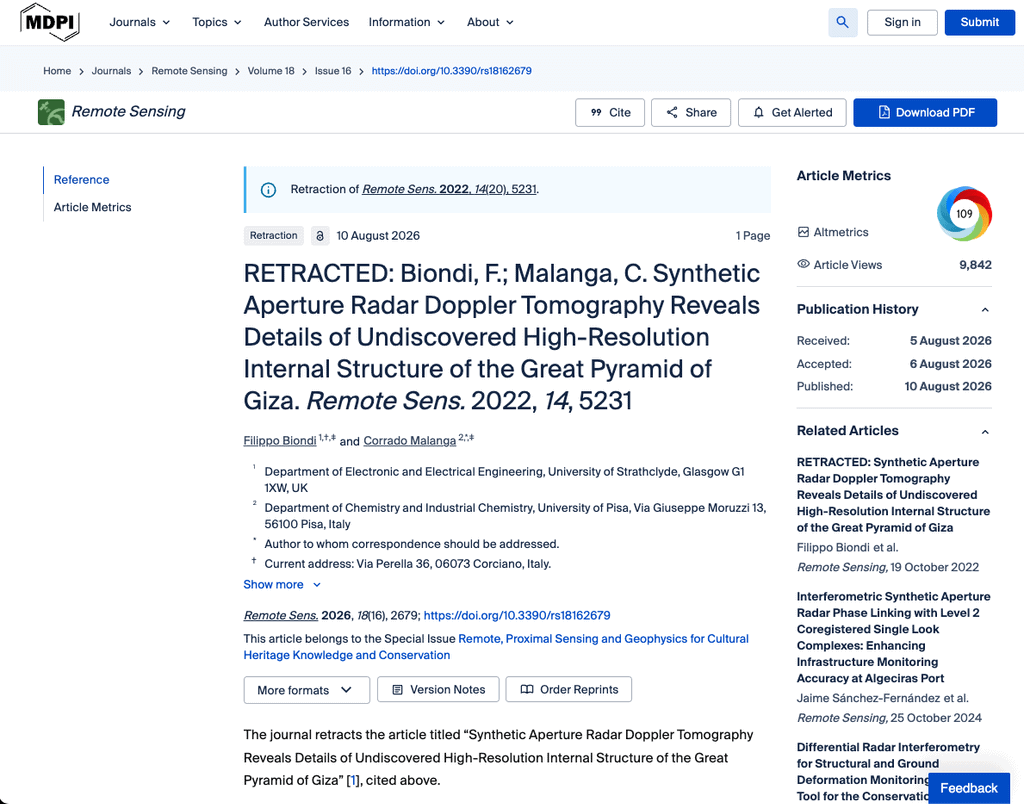
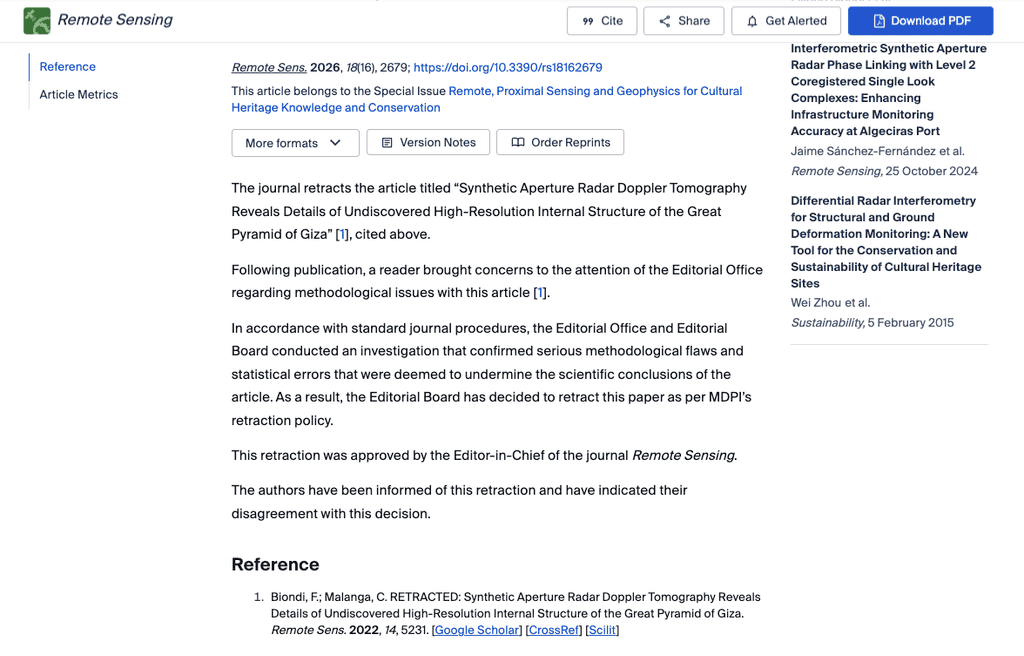
Paper Retraction: https://www.mdpi.com/2072-4292/18/16/2679
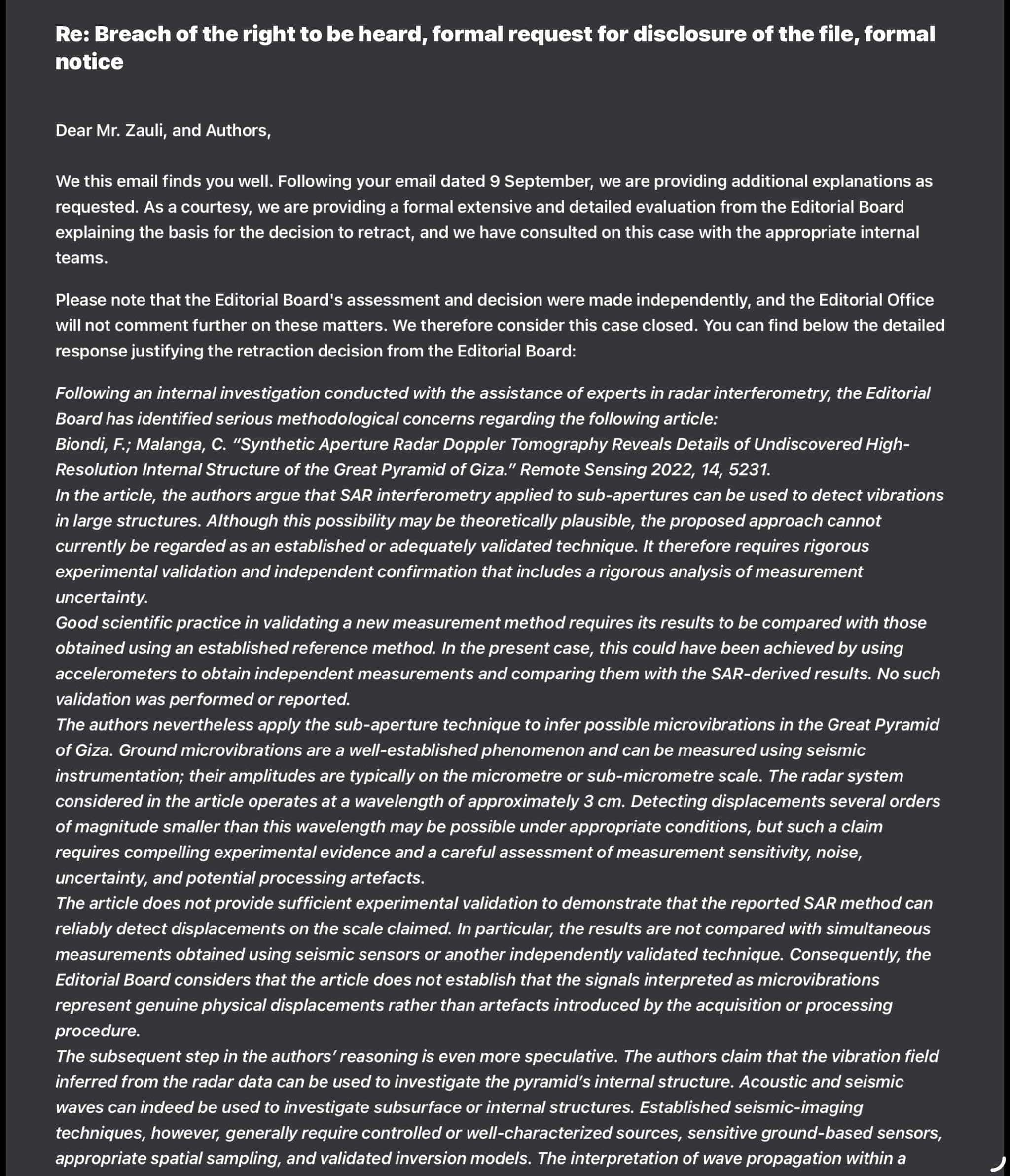
Biondi and Malanga diplomatically requested the specific reasons for the drastic decision to un-publish the paper, in an effort to bring the alleged issues openly into public debate. They received only empty responses from the journal representatives, until finally getting an official response that still failed to address anything specifically wrong with the paper. The response was essentially saying that the method was simply too untested for them to put full faith in the results.
In my view, the only fair point they made throughout the statement, was that the method must be tested against known industry standards like ground penetrating radar, seismic tomography or electrical resistivity tomography. However:
- I have personally compared the SAR data to GPR data and shared this information publicly, for instance, in this video.
- Comparing it to GPR and other types of remote sensing is far inferior to comparing it with literal known structures that we can walk inside, have blueprints for, and know the exact shape of.
- We are presenting far more evidence today that it has successfully been tested against GPR and ERT results.
With the journal finally stating that they consider the matter closed, Biondi and Malanga had no other choice but to take legal action to defend their work.
Today, we bring a reckoning to all those who have unjustly slandered the name and work of Dr. Filippo Biondi, in the form of verifiable results from a third party, completely independent from the Khafre Research Project and HarmonicSAR, that illustrate the very same chambers beneath Giza, and which were created using the very same technique.
Not only will we prove that Biondi has been unjustly treated, and that he has reacted professionally to the situation, but most importantly, that his method works. It has been reproduced by a completely independent source, with matching results; actual tomographic scan images that are published below, courtesy of Dr. Manu Seyfzadeh.
This is the proverbial ‘final nail in the skeptic’s coffin’. The process is real and it works.
Final response from MDPI Remote Sensing Journal (shared with me by Corrado, with permission to publish):
Good Science, Bad Science
Dr. Biondi has publicly called out the hypocrisy of the journal, in that while they retracted his paper on the Great Pyramid, they did not retract another of his papers they published, which was focused on Mount Vesuvius, though it was using the exact same technology. In both papers, the process and research described was identical, with the only difference being the target location studied. Filippo asked a logical question.
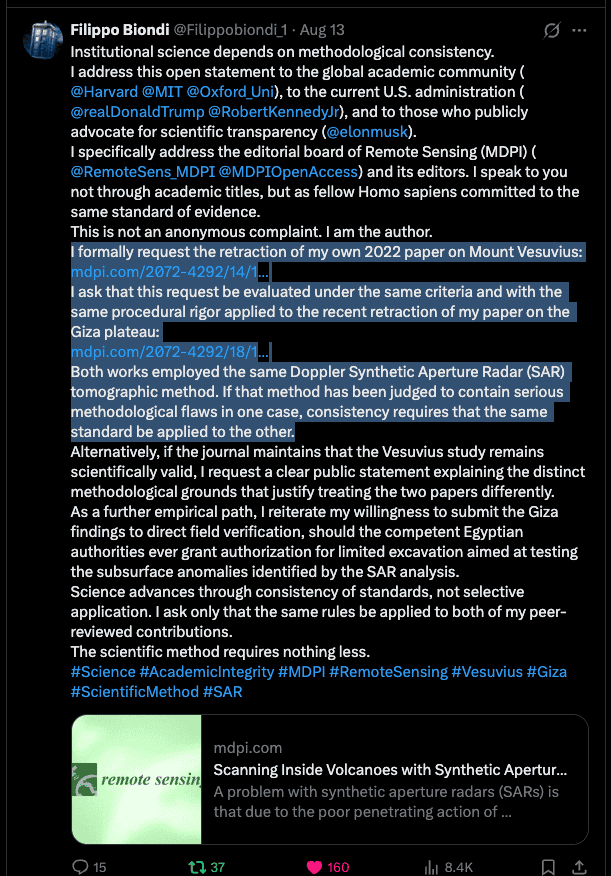
Why is his method considered ‘good science’ when applied to a volcano, but ‘bad science’ when applied to an archaeological discovery that challenges history as we know it?
There is only one logical conclusion. The decision to retract the paper was not scientifically motivated, but politically motivated. The inability of the accusor to provide any evidence whatsoever to back their charges is an obvious admission that their accusations are baseless, false, and based on an agenda entirely unrelated to science. Whether this agenda exists within the journal’s editorial board itself, or was really an outside, anonymous source putting pressure on them, is not fully known, but it is clear that their investigation and re-evaluation of the paper was prompted by a complaint from an unknown outside source.
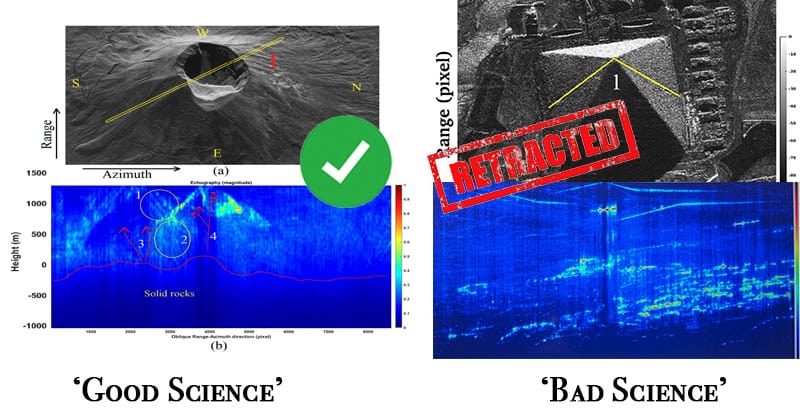
Biondi and Malanga have requested that we publish the litigation document below, which they have sent to the journal’s editorial office.
The Archaeological Rescue Foundation will publish further updates regarding the legal proceedings as they occur, on our ArchaeoSAR Home Page. In the meantime, Filippo’s technology has been validated beyond dispute, if it wasn’t already.
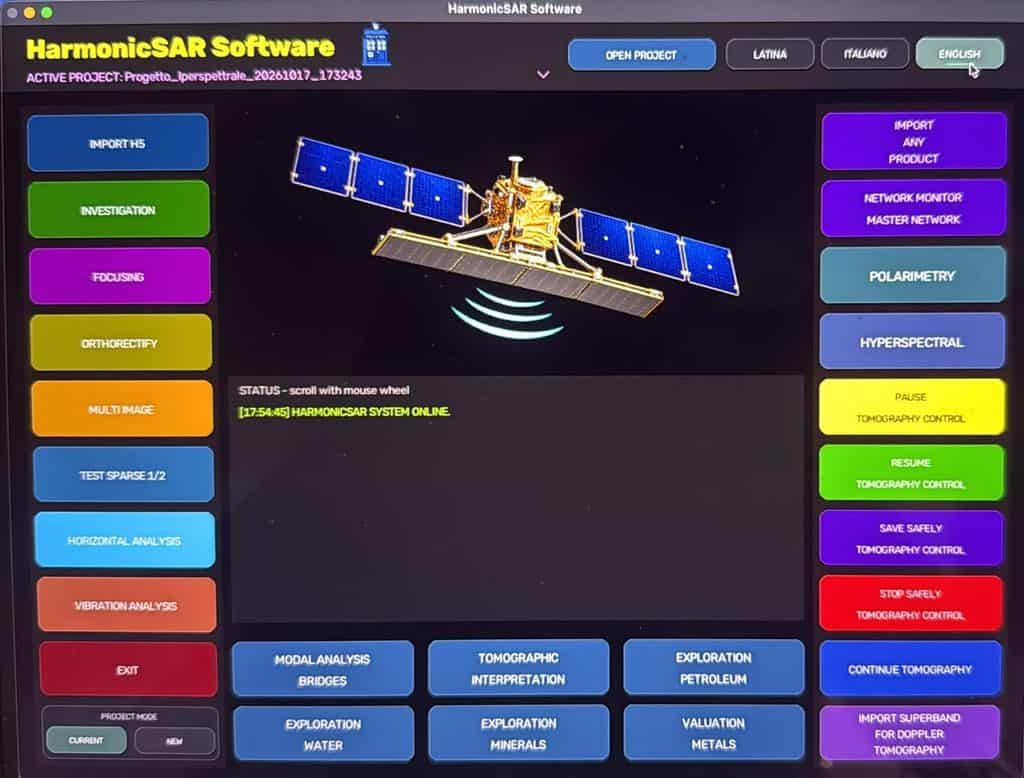
For one thing, the HarmonicSAR software may soon be commercially available to the public in the form of a simple desktop application. We can only imagine how many confirmations of the method will be public when anyone can use the software. We will see countless scans accurately portraying known structures underground, and though Filippo has already shown us this many times over, soon we will see scans from others working independently, but showing the same. In fact, it has already happened.
The Validation
Dr. Manu Seyfzadeh, working as a completely independent researcher, with no ties to the Khafre Research Project or inside information regarding the Biondi Protocol, has reproduced the method and shown matching results.
This is officially the final straw on the skeptical camel’s back. For those who would go as far as to claim that the hundreds of tomographic images Filippo has supplied were somehow fraudulently generated, there is no longer any argument to turn to.
I can personally attest that Manu was working only with information that had been publicly released, and was never given any inside knowledge from Filippo. I know this because I was in constant communication with them both, attempting to arrange a conversation between them for some time, until I finally succeeded, once the evidence was ready. Manu and I were both analyzing and discussing the now-retracted paper on the very first day it was published, and soon after, he shared a video review of it.
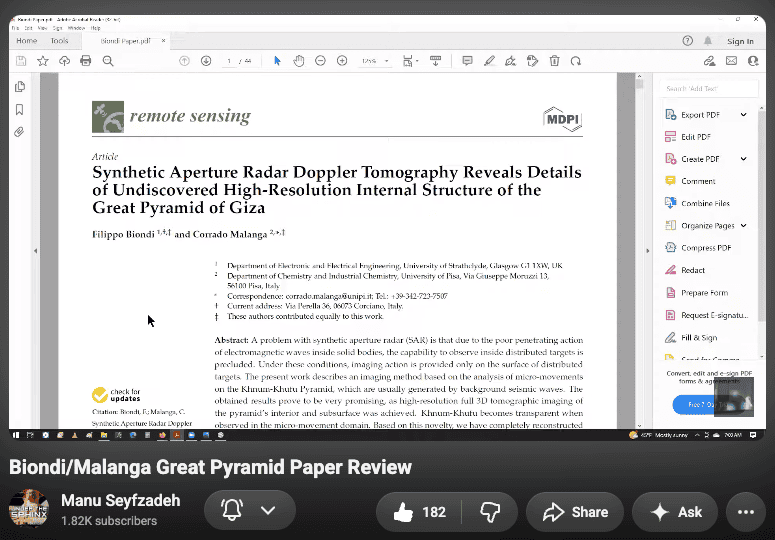
Manu paper review 2022: https://www.youtube.com/watch?v=gmYoJV7lZAE&t=5s
As he was researching deeper into the method, Manu gave me a transcript of a conversation he had with ChatGPT regarding the technical and theoretical principles involved with Biondi’s complex filtering algorithms. He allowed me to publish the text, which to this day, is probably the most detailed written description of the process published on the internet, aside from Filippo’s own report. Despite it admittedly going over my head at times, usually due to unfamiliar terminology, it is nevertheless an invaluable document for those who are truly interested in the math and physics involved, and the basic principles are easy enough to comprehend.
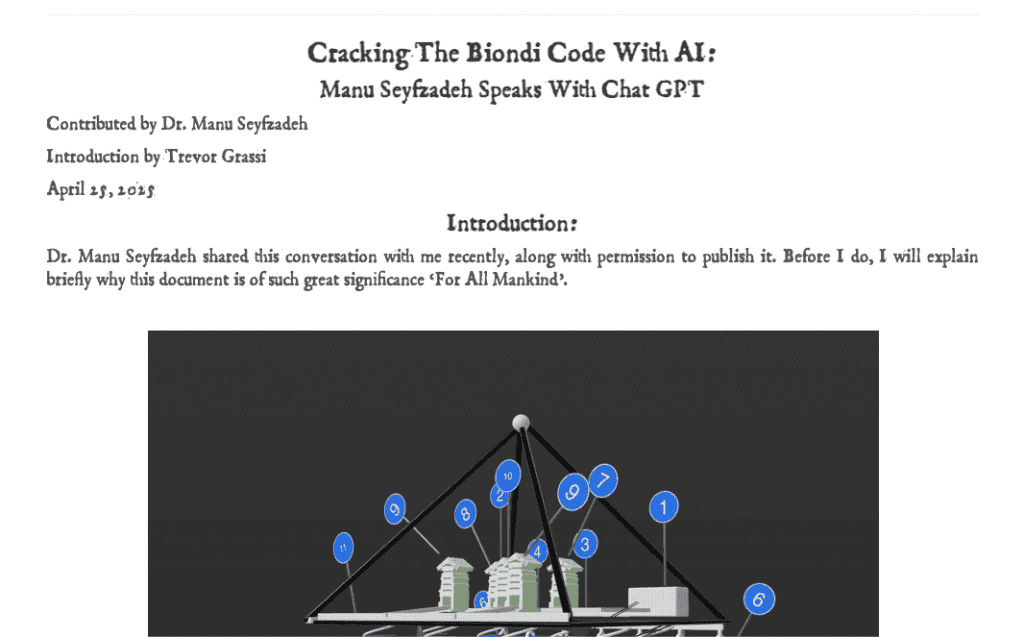
Even still, it’s not entirely necessary to understand the complex filtration software if, in practice, you can actually witness it working. So, as they say, a picture is worth a thousand words.
Manu Seyfzadeh scan analysis
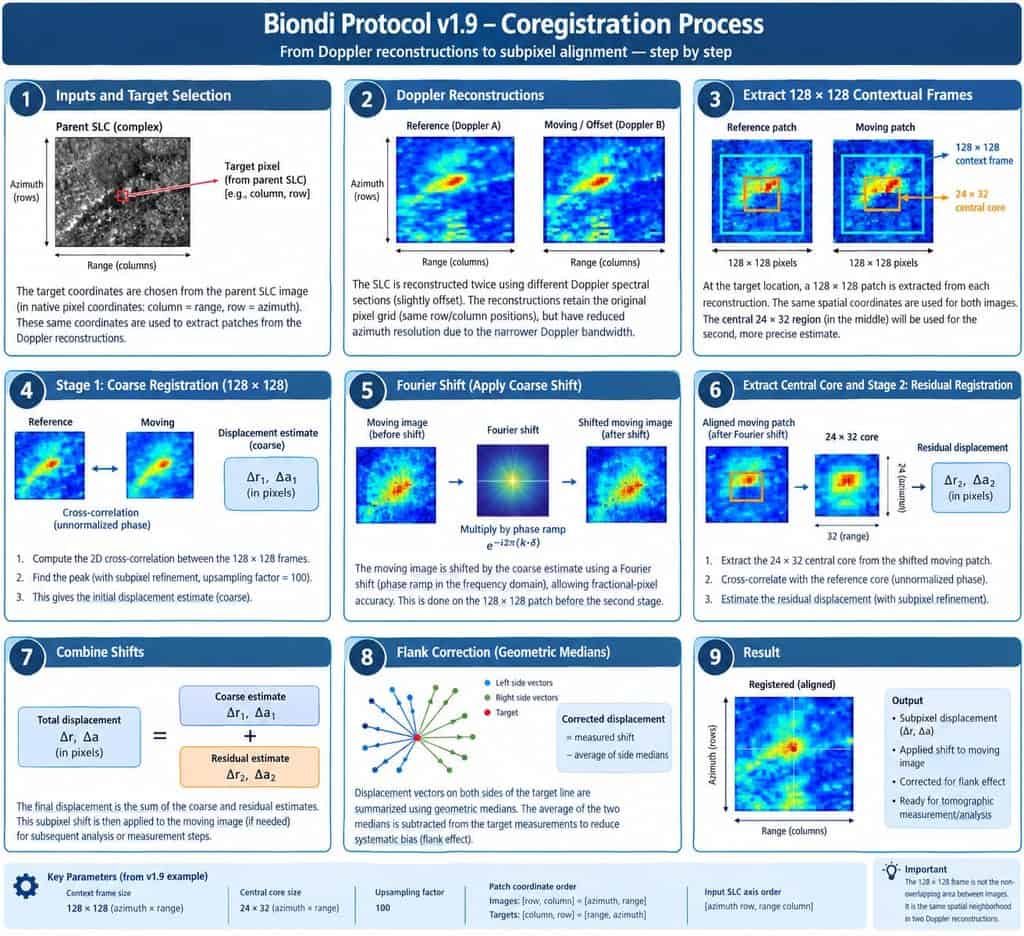
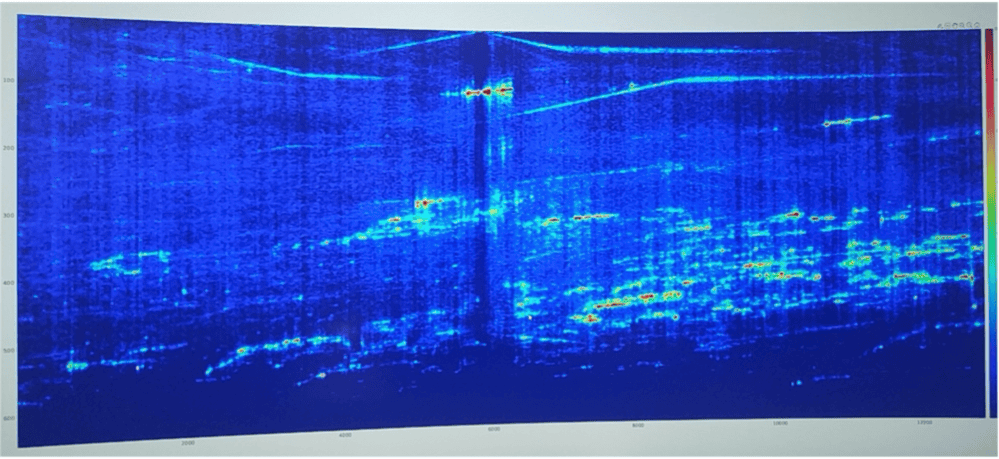
Manu shared the image above that illustrates his process, which is based on the publicly known aspects of the Biondi Protocol. The aspects that are unknown (proprietary), he has attempted to discover through experimentation. Beginning in August of 2026, he began publicly posting results of his own scans at Giza on Facebook. [LINK]
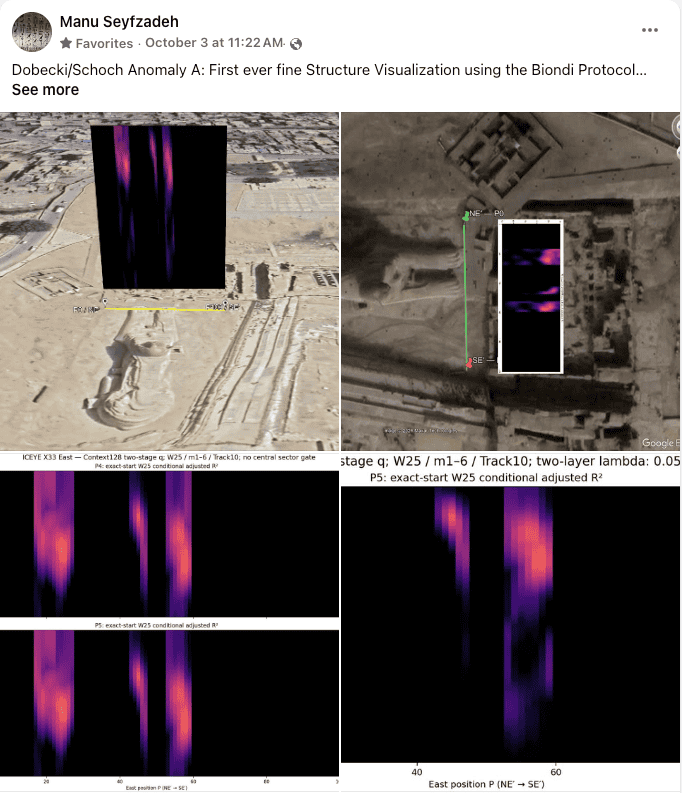
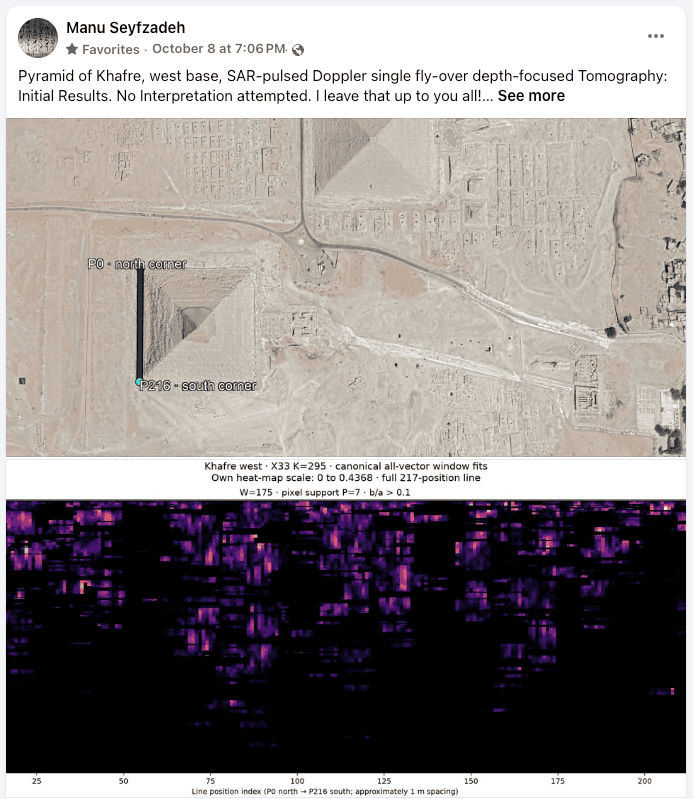
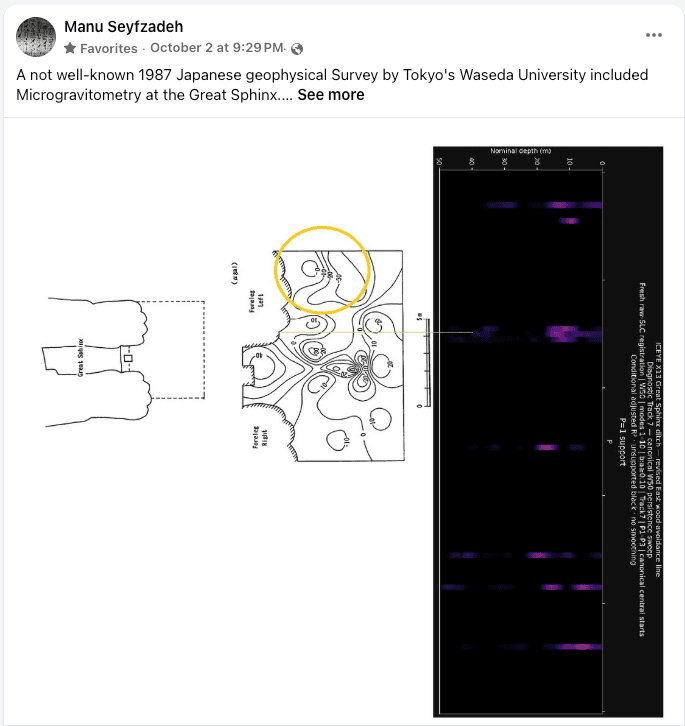
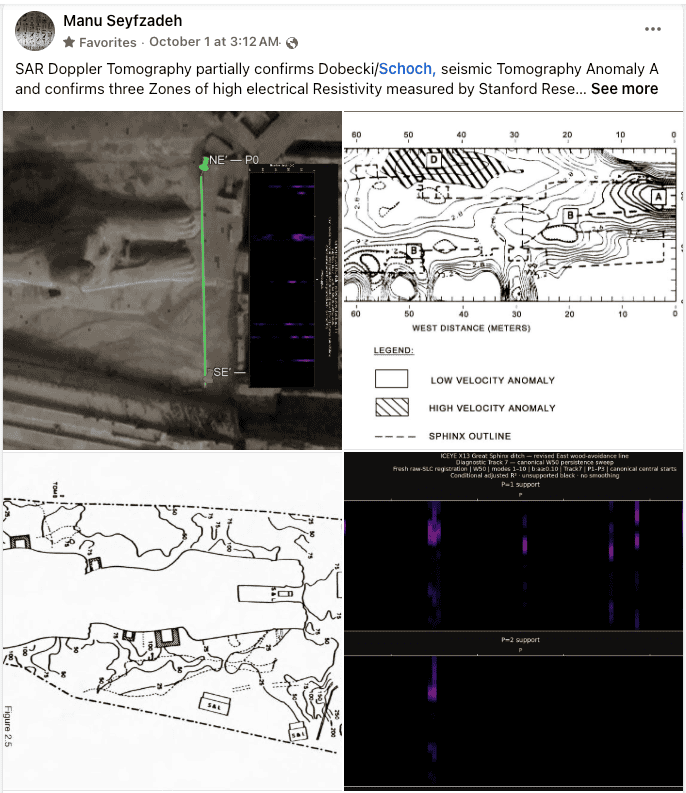
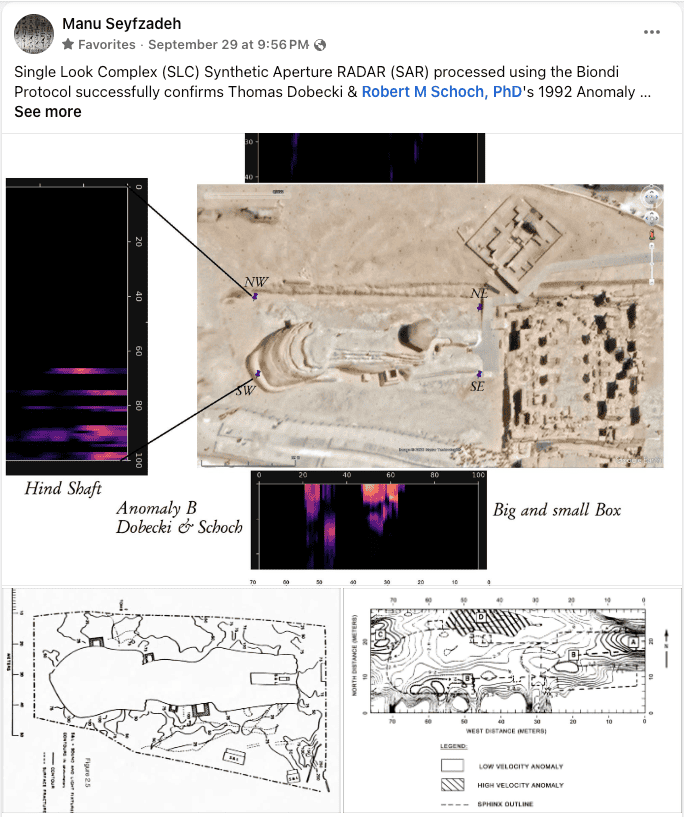
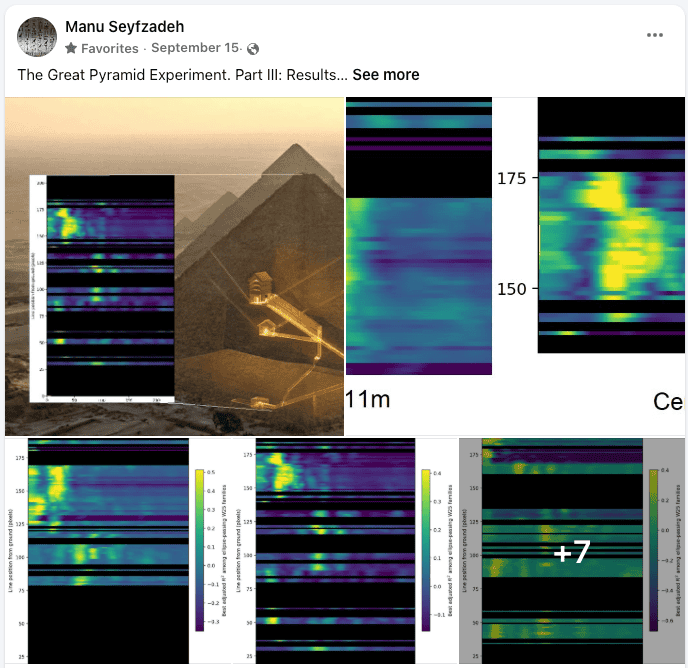
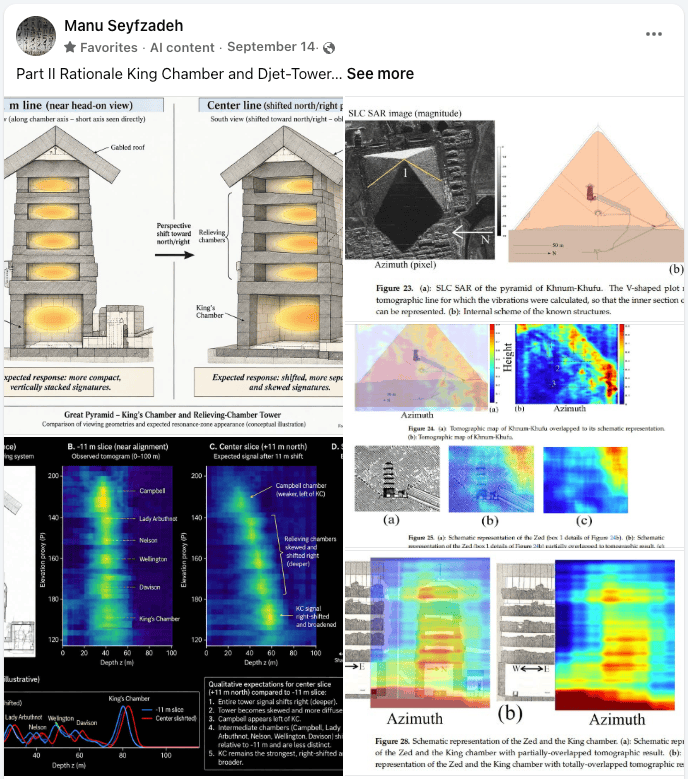
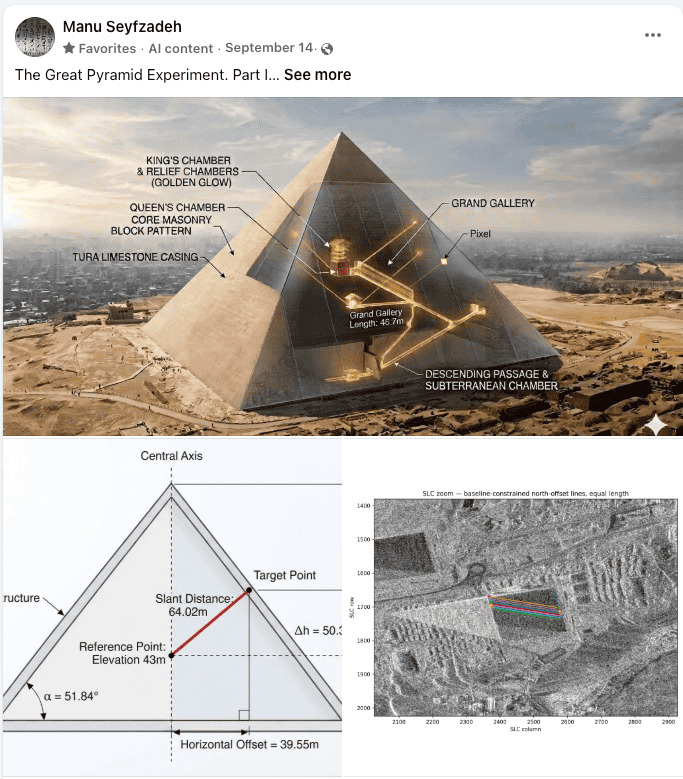
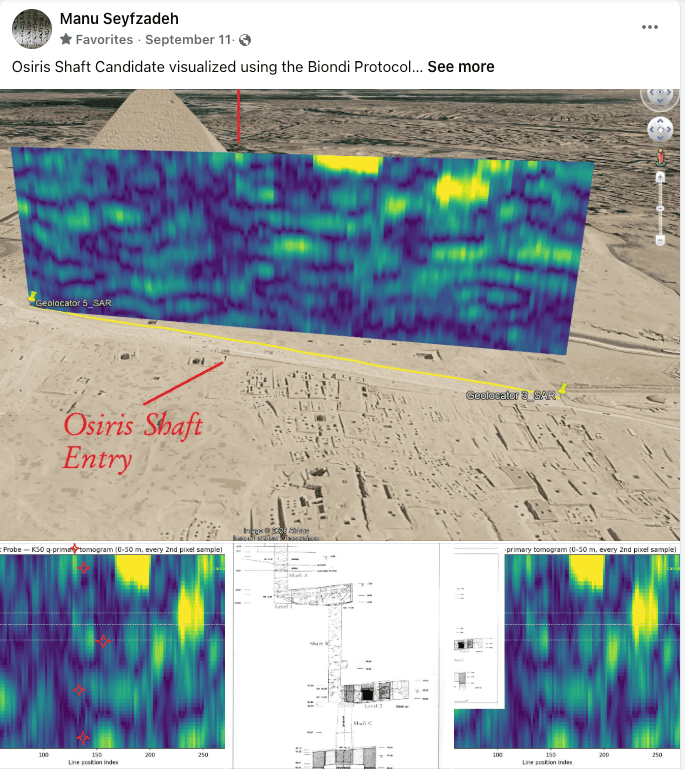
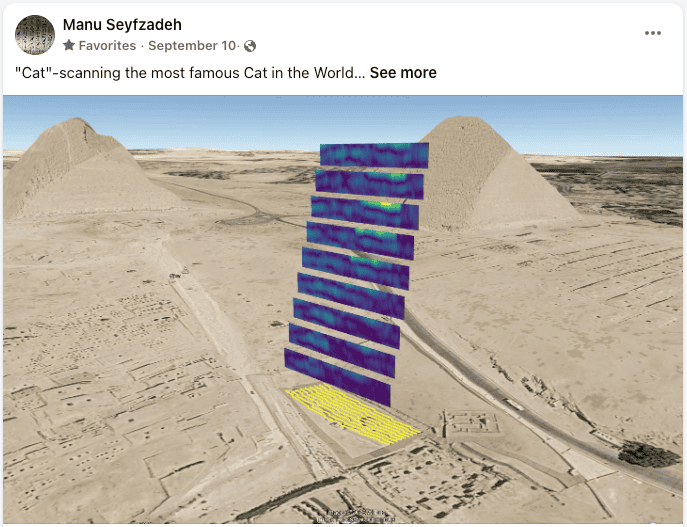
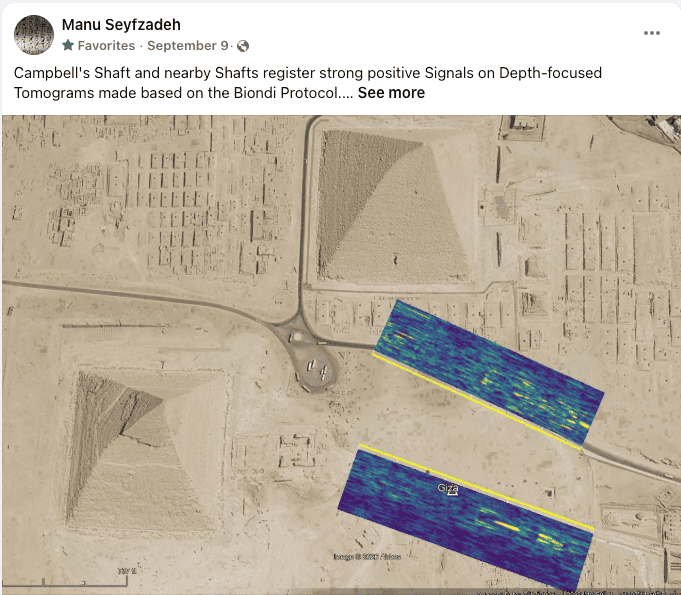
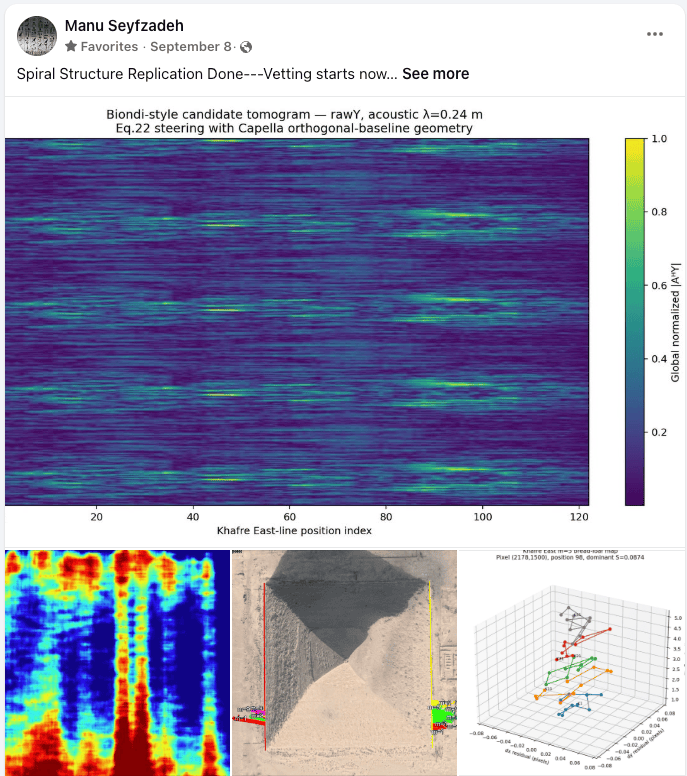
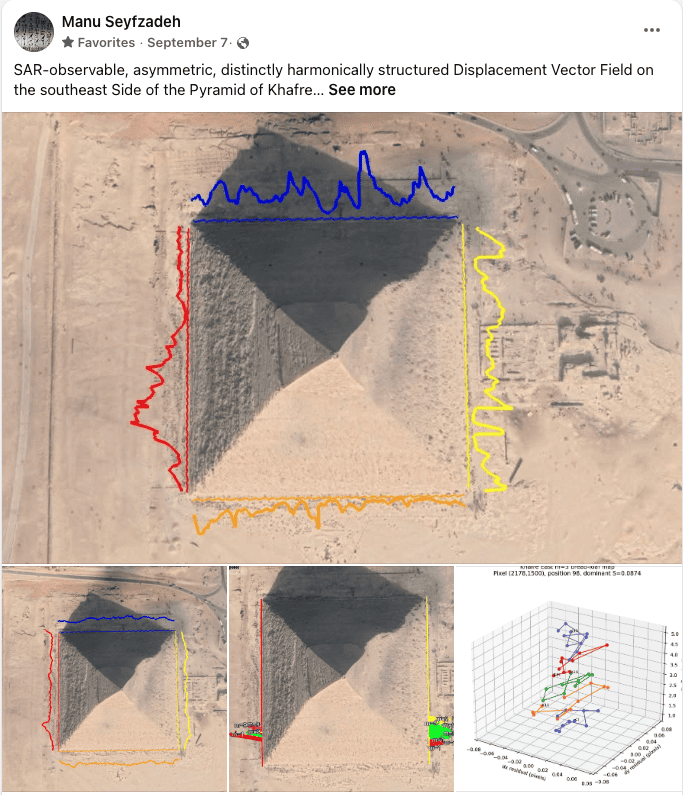
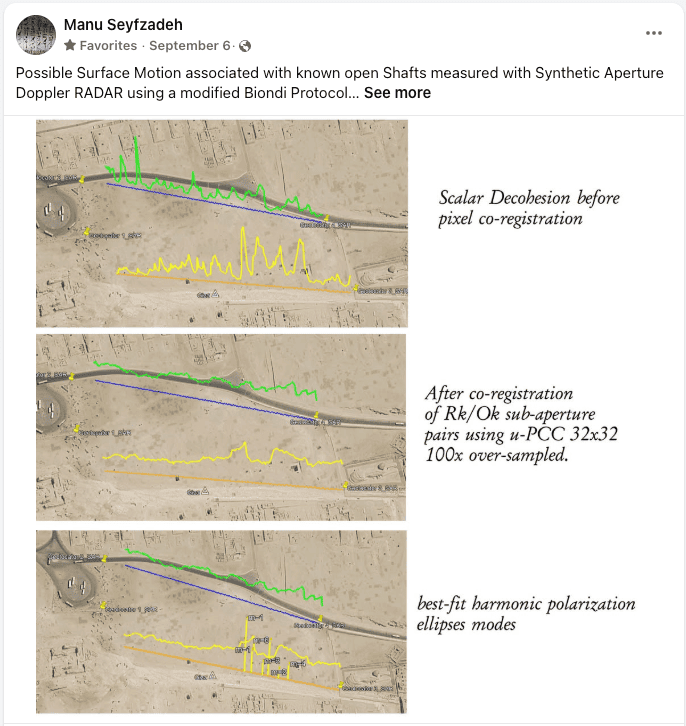
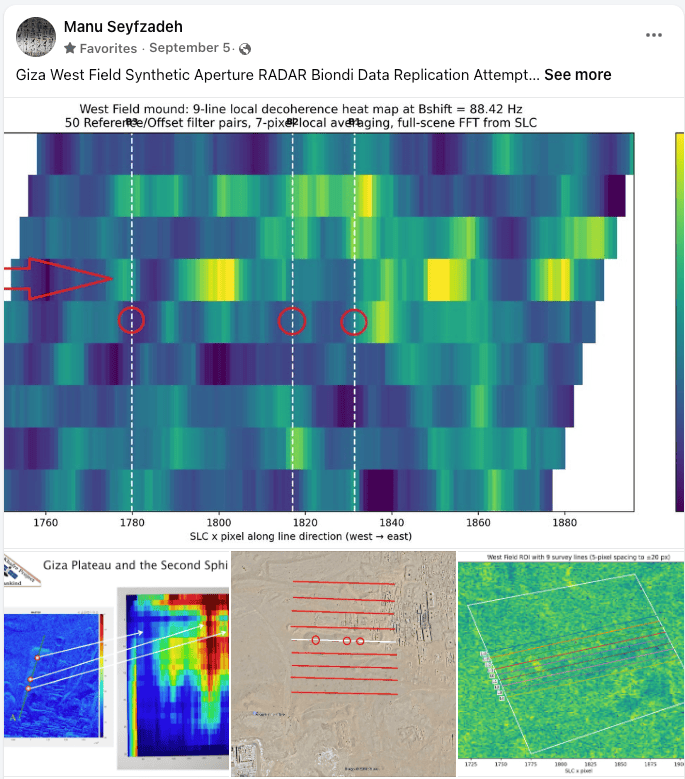
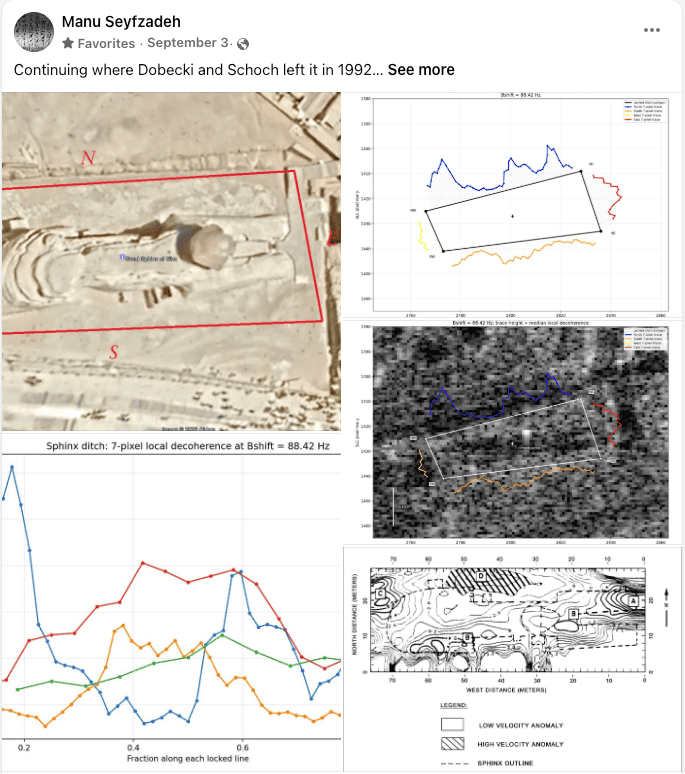
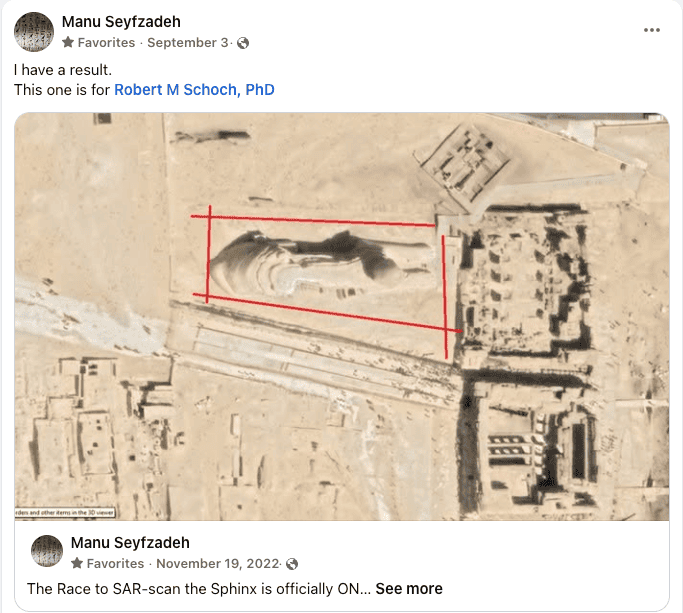
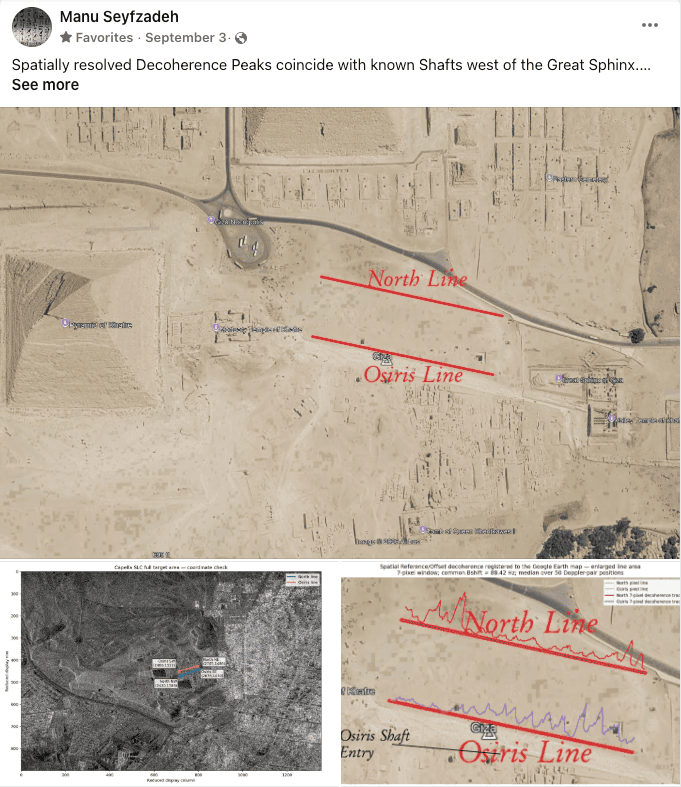
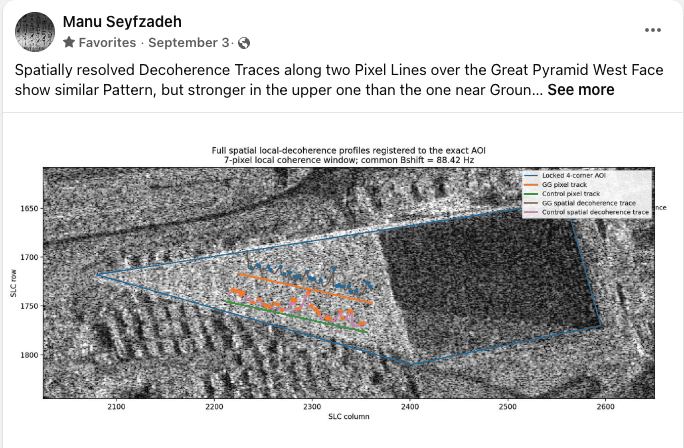
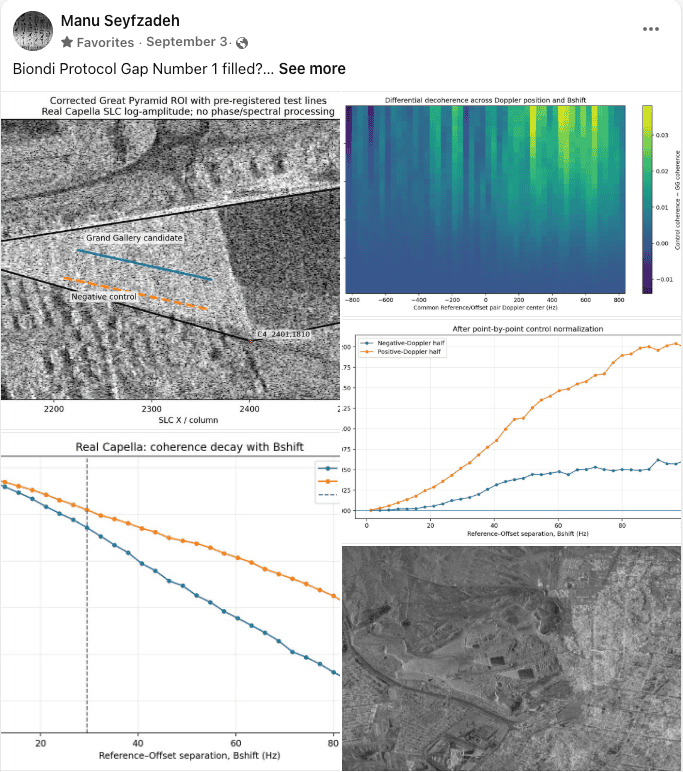
When Manu, Filippo and I finally reviewed the scans together, the verdict was in – the reproduction of the method was successful. Filippo was greatly impressed by even the initial tests Manu performed, but then we took a closer look, comparing the images directly against Filippo’s.
Khafre Pyramid Control Test
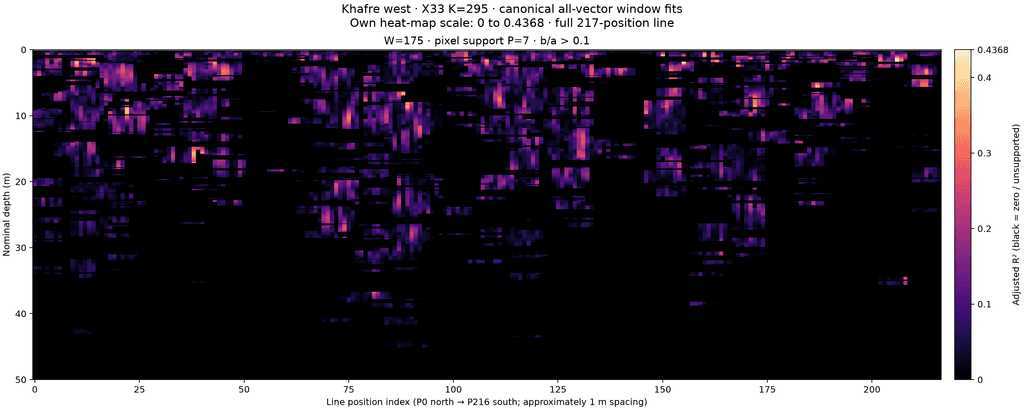
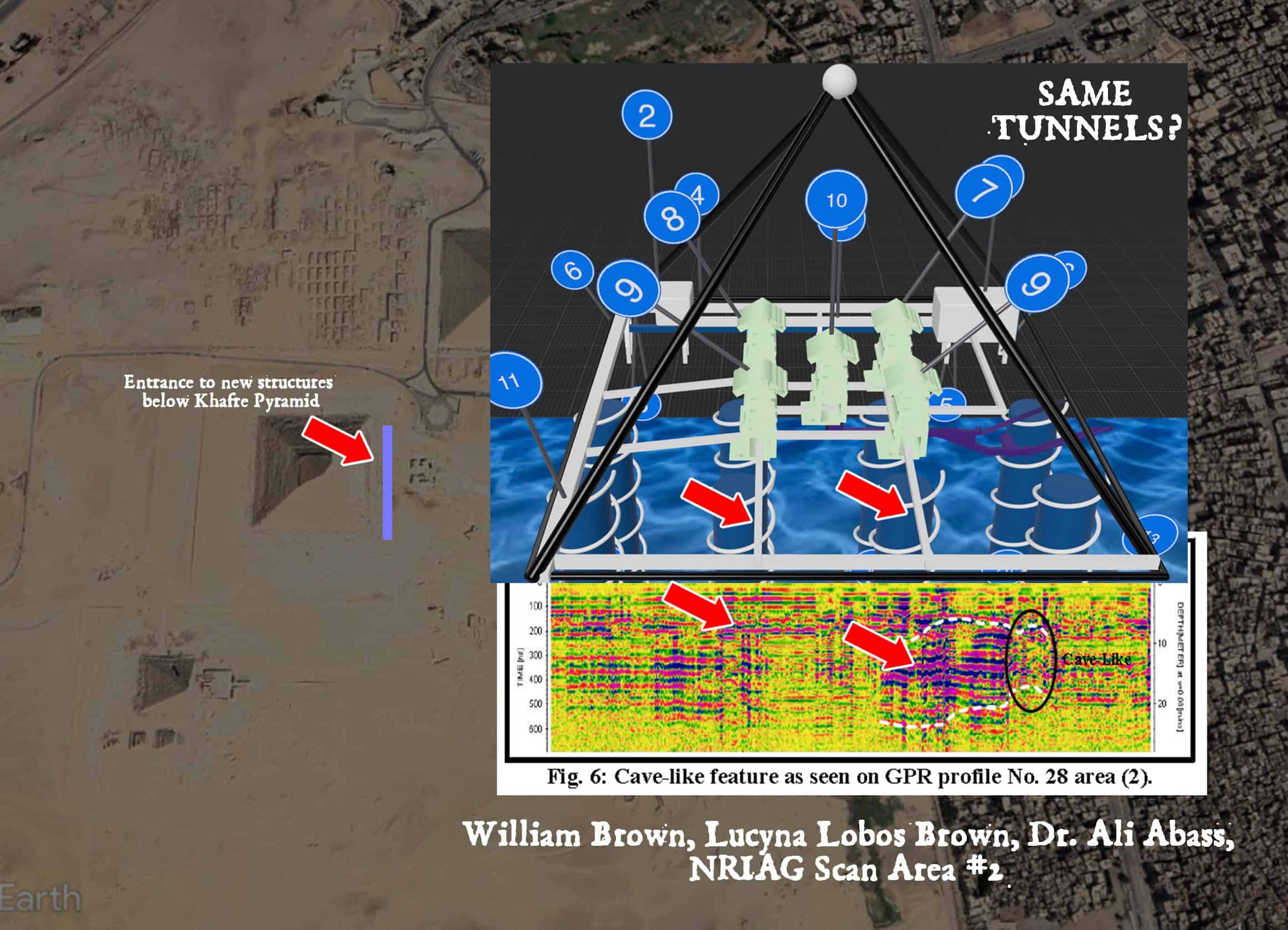
In these first two scans by Manu, we find broad correlations at least, to both Filippo’s scans and also to GPR scans conducted in the same location in 2006. I’ve covered the 2006 GPR scans thoroughly in my series The Secret Underworld of Giza, which were carried out by the National Research Institute of Astronomy and Geophysics (Egypt), as well as the University of Wroclaw, Poland. Here I simply show a quick comparison.
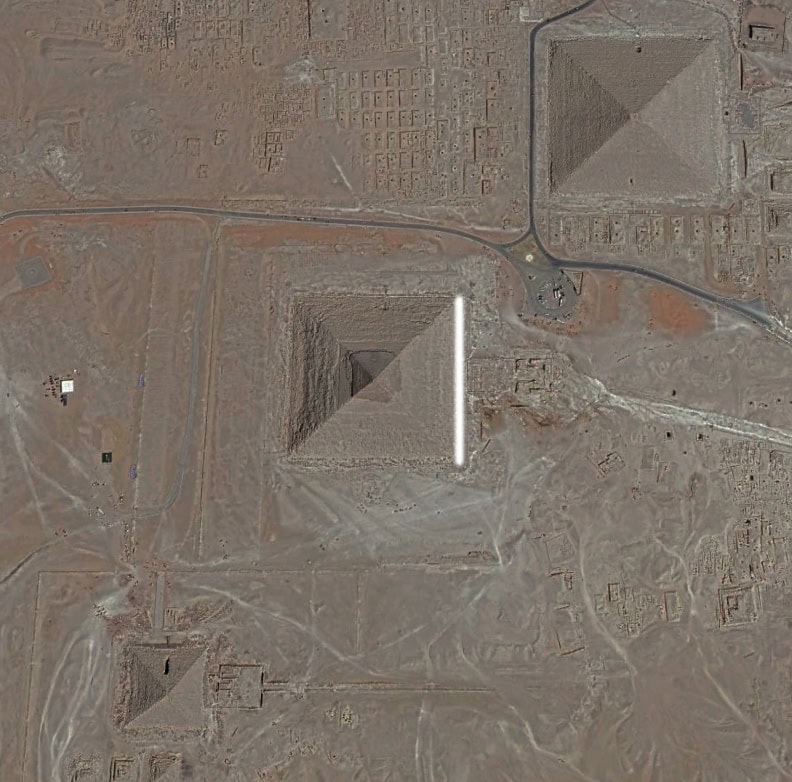
The first is a scan of the Western Base Edge of the Khafre Pyramid (G2):
The second image is of the Eastern Base Edge, which is where the GPR scans were also done:
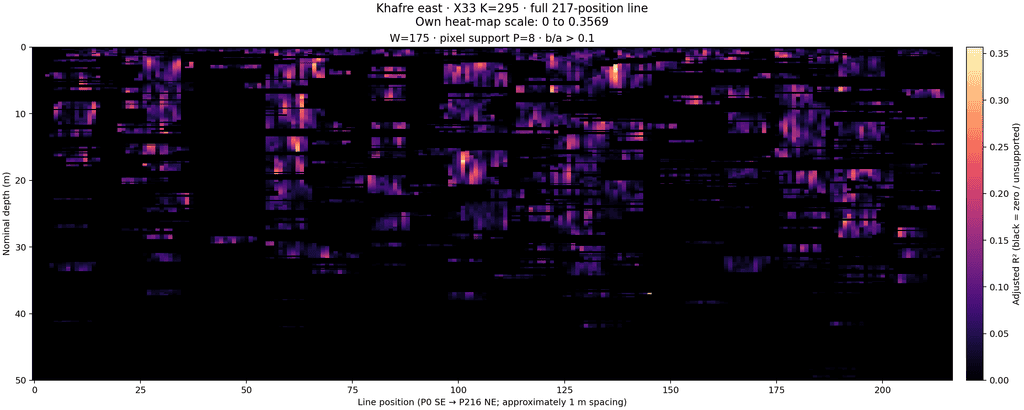
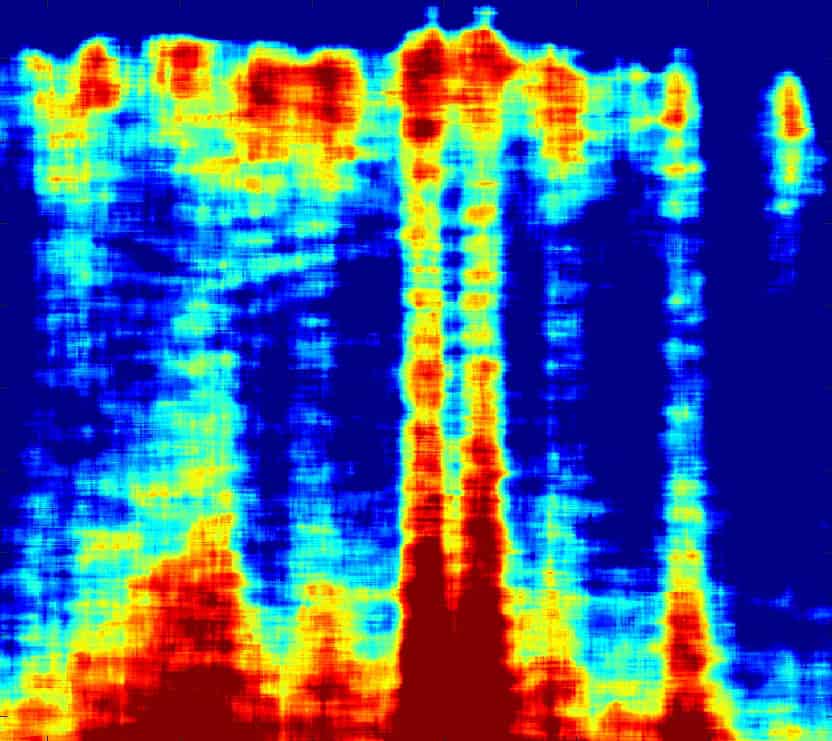
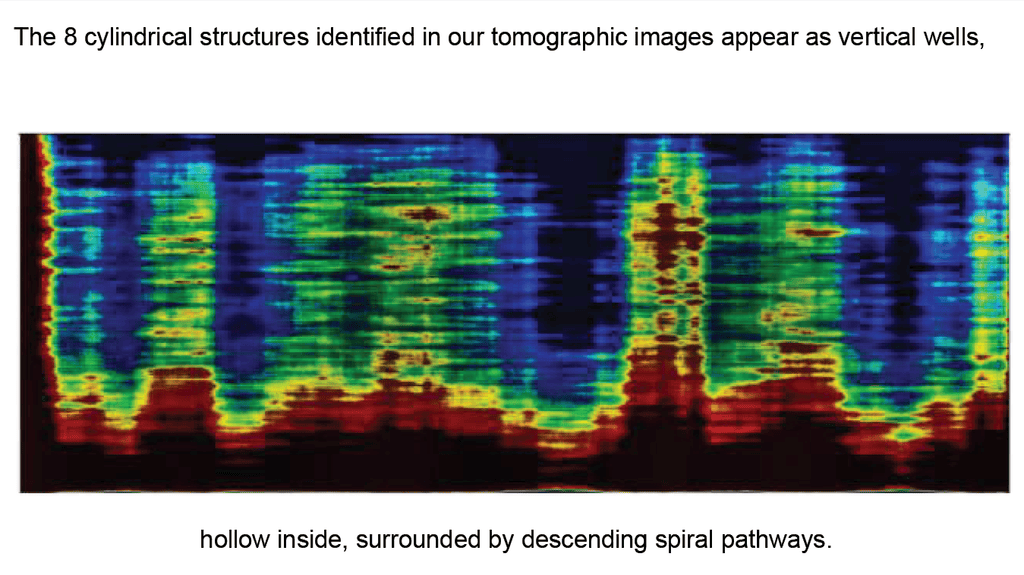
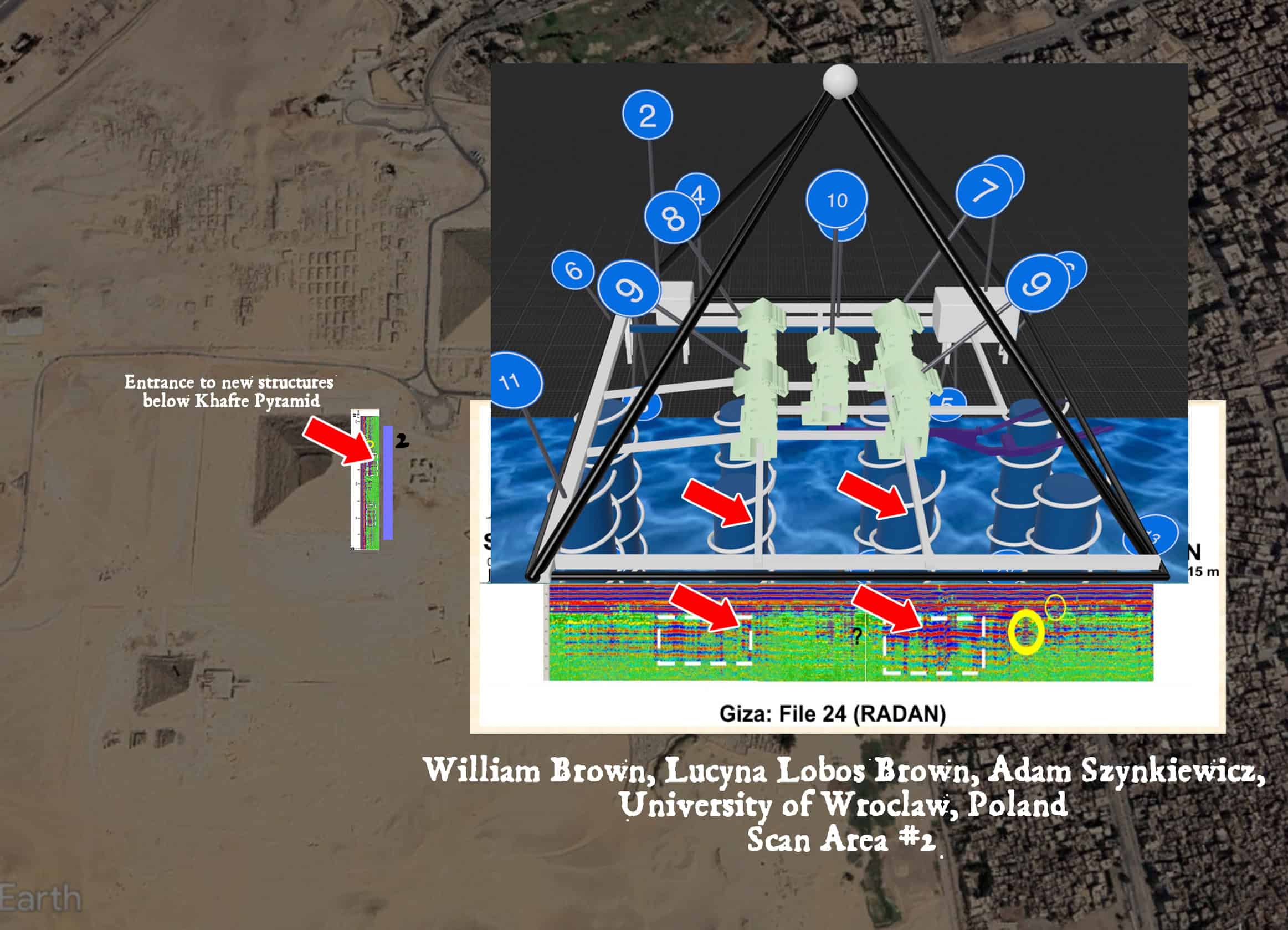
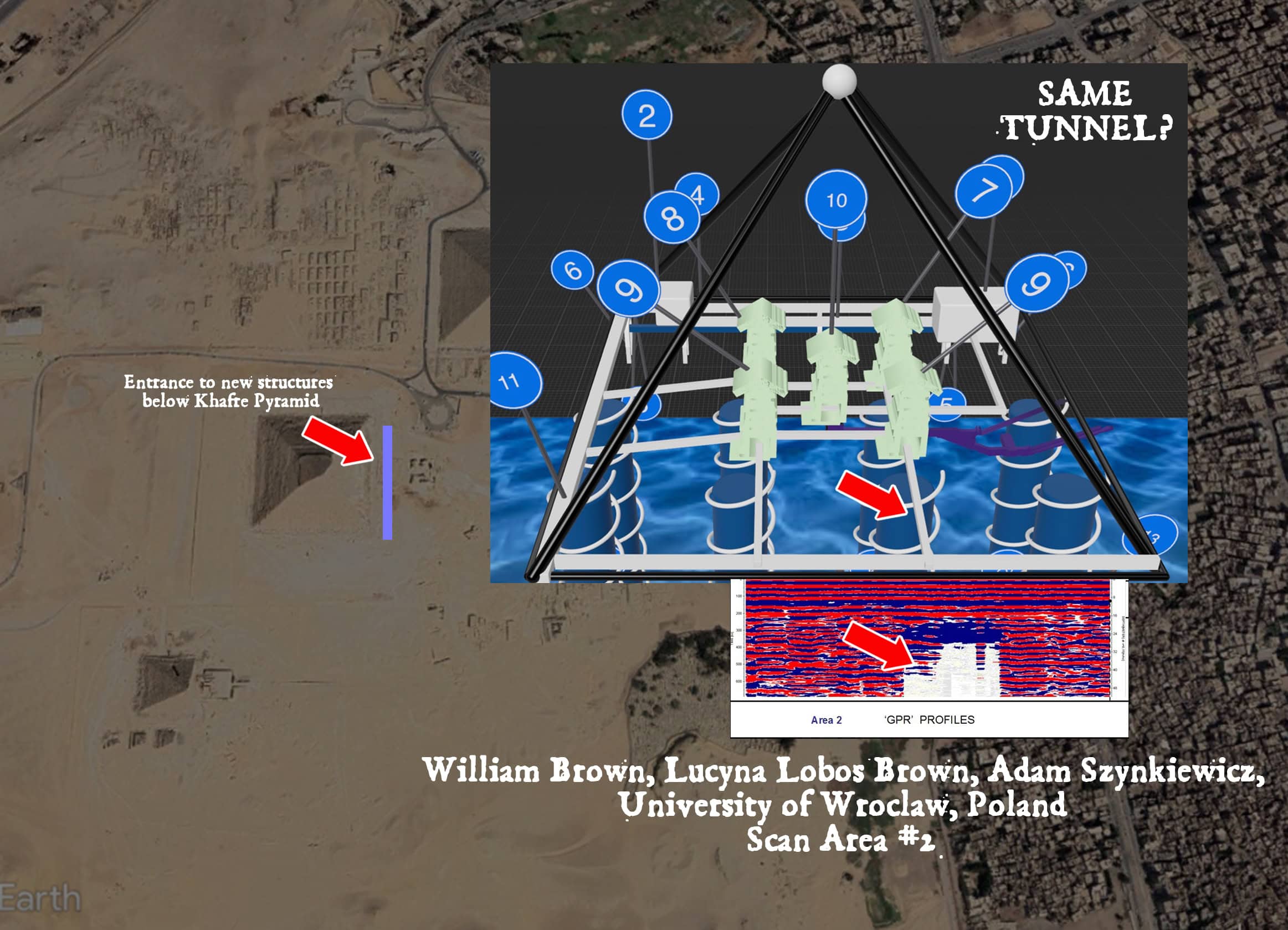
Along both the Eastern and Western base edges, forms can be seen in the shape of huge columns, just as Biondi had claimed.
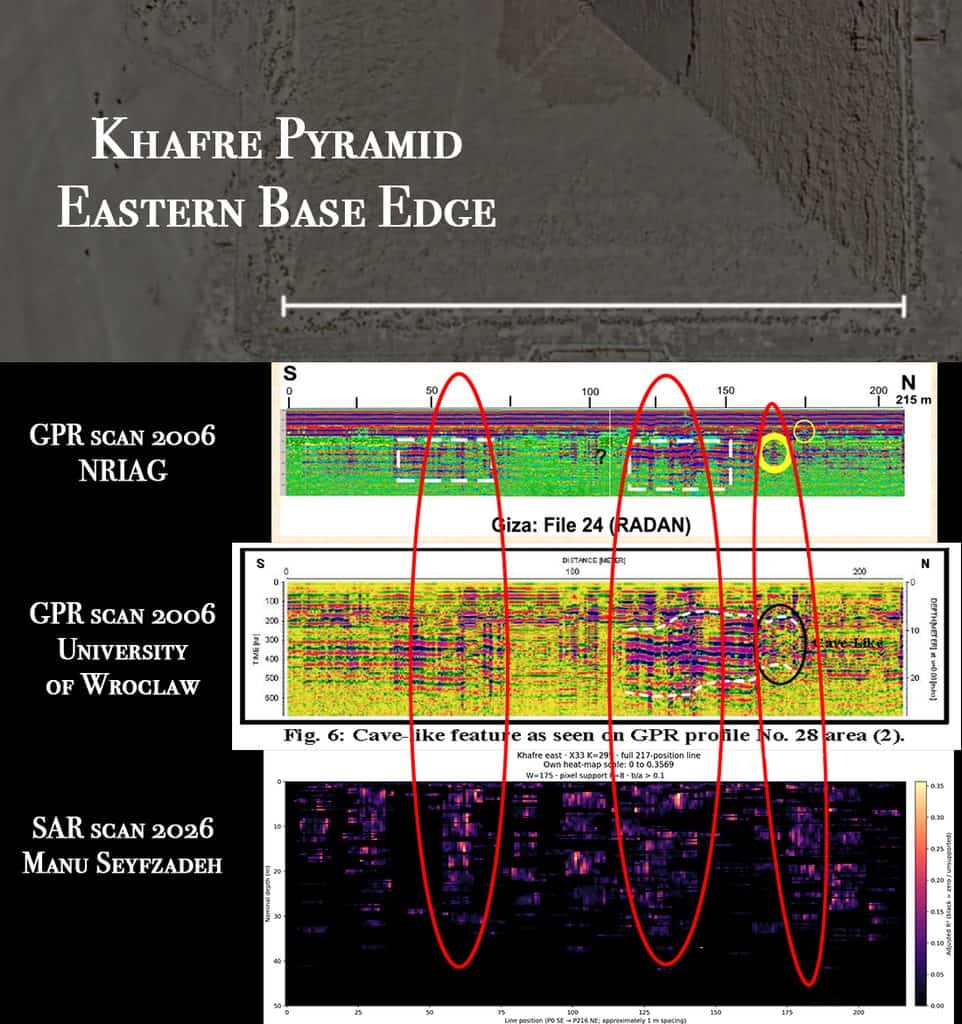
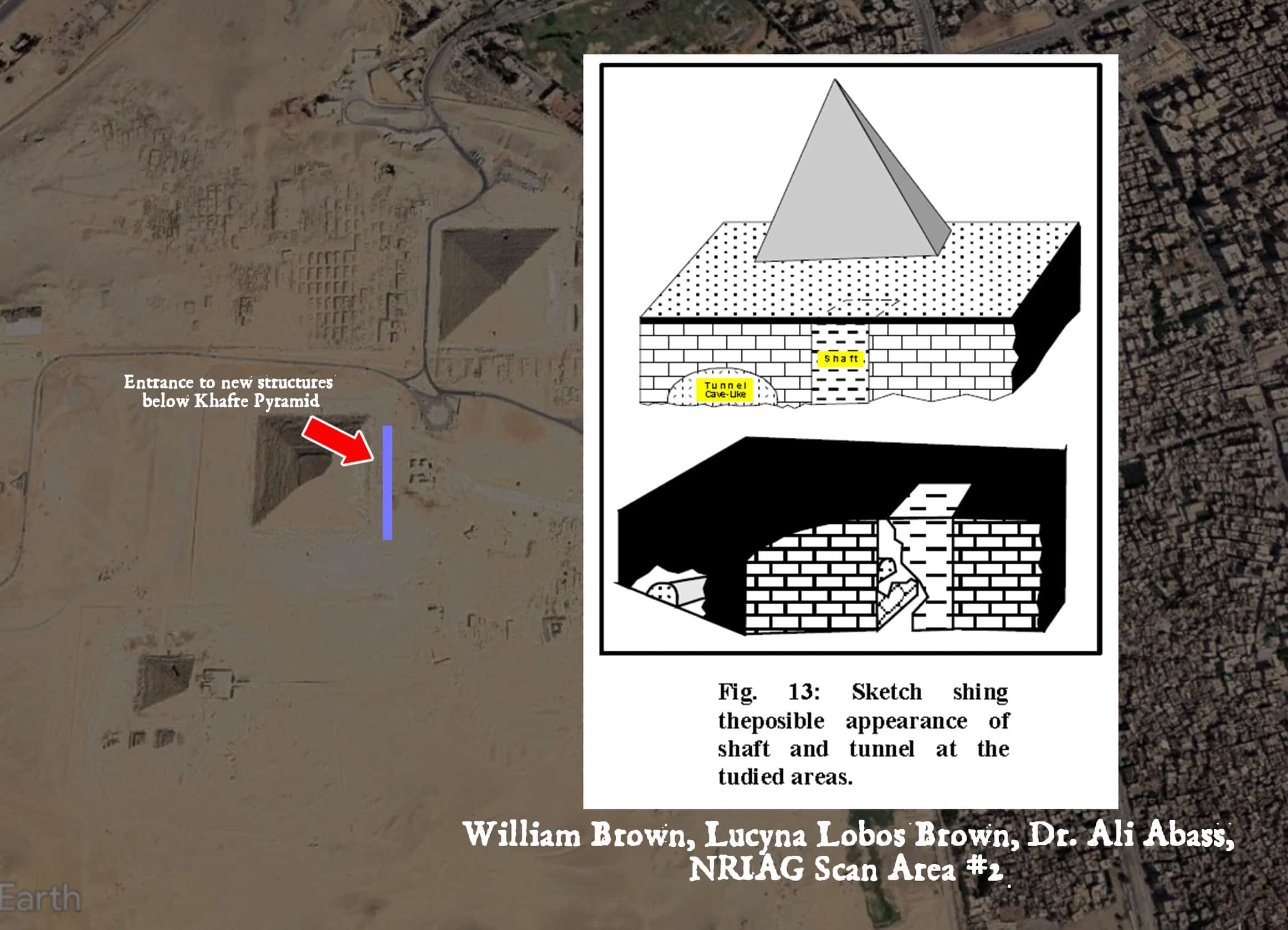
Two anomalous zones roughly divide the length of the scan in thirds, showing potentially two entrances leading under the Pyramid at these intervals. This corresponds perfectly with two tunnels shown emerging from within the pyramid in the Khafre Project model. Dr. Abbas of the NRIAG even indicated that he believed these anomalies were tunnels entering under the pyramid, as he illustrated in his 2006 report.
Osiris Shaft Control Test
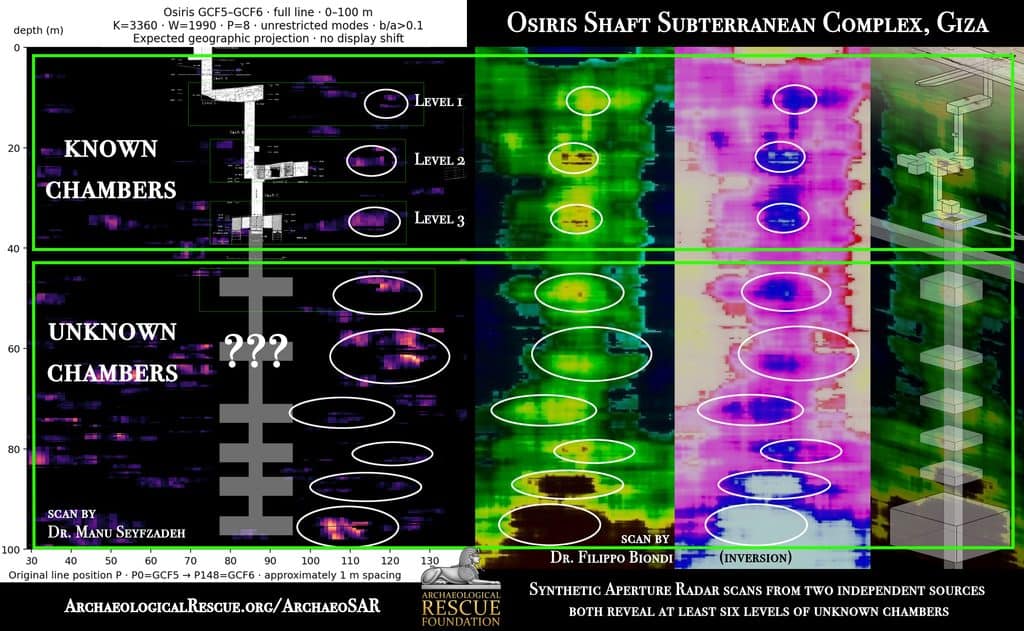
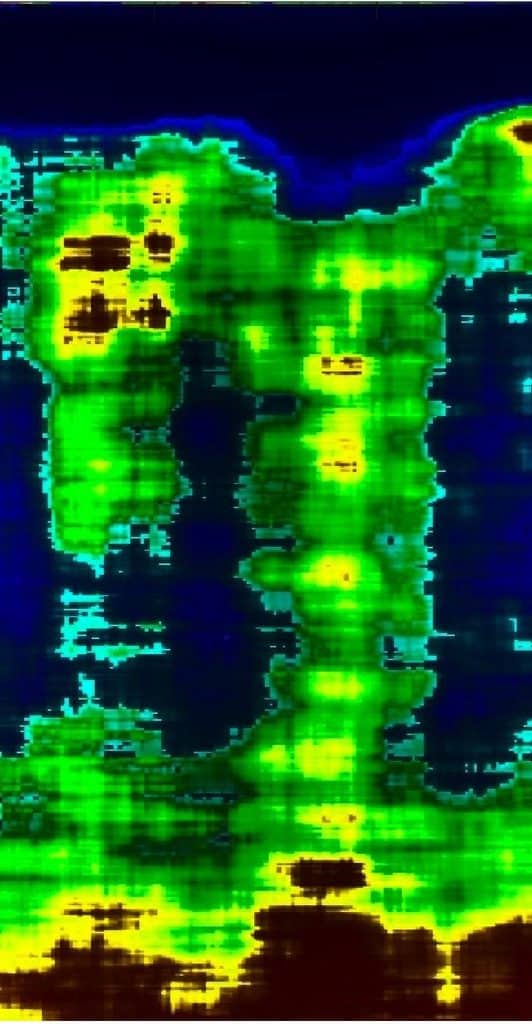
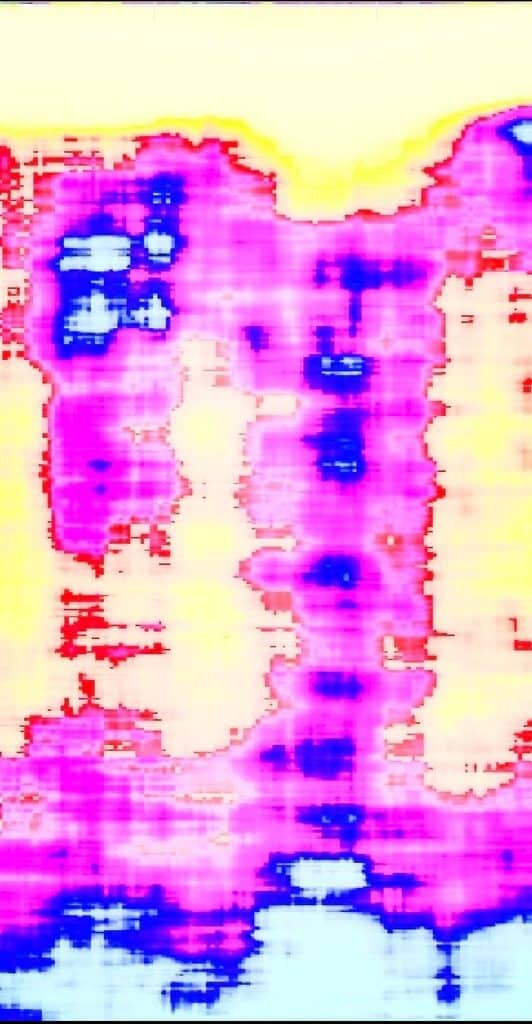
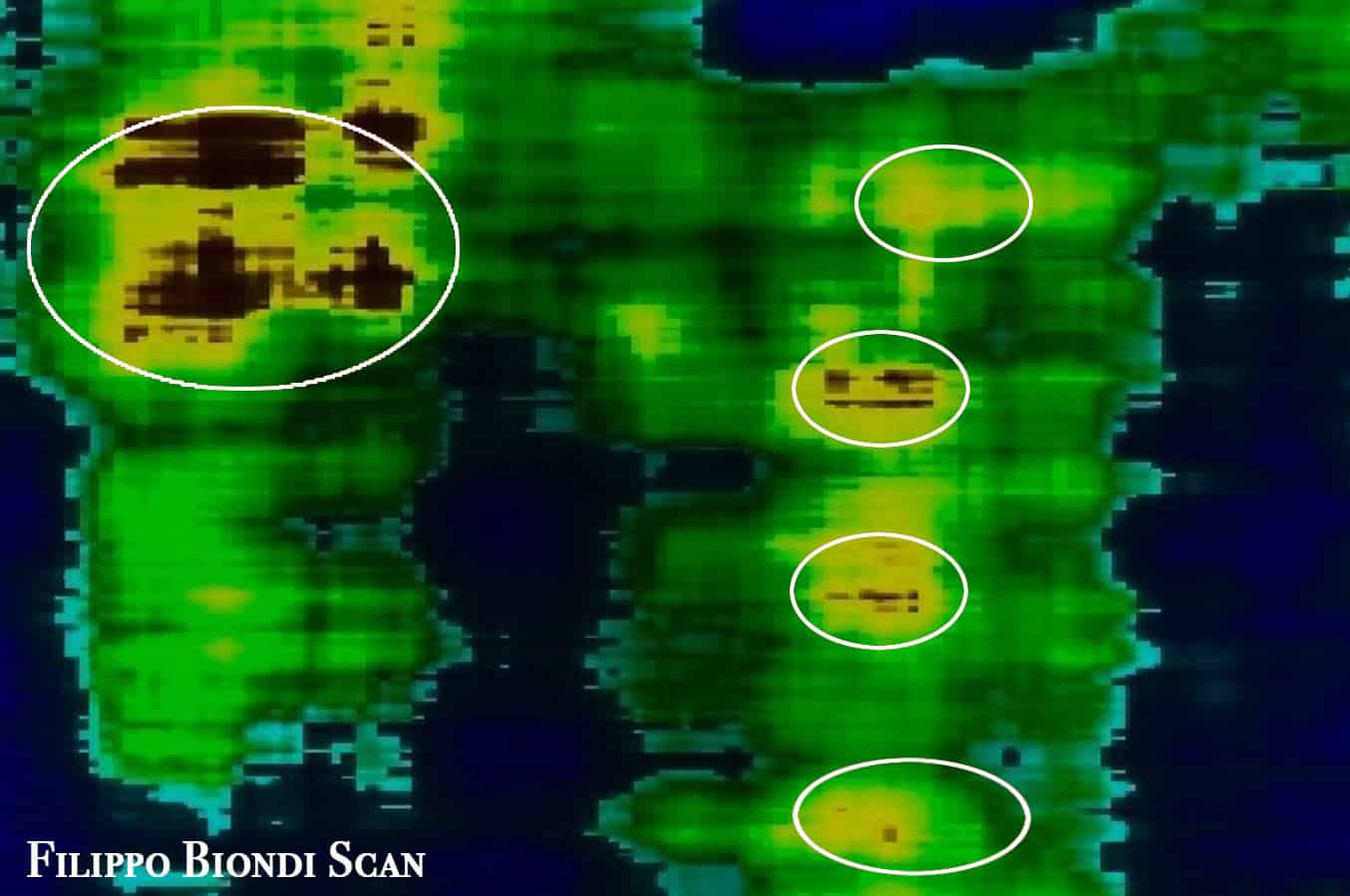
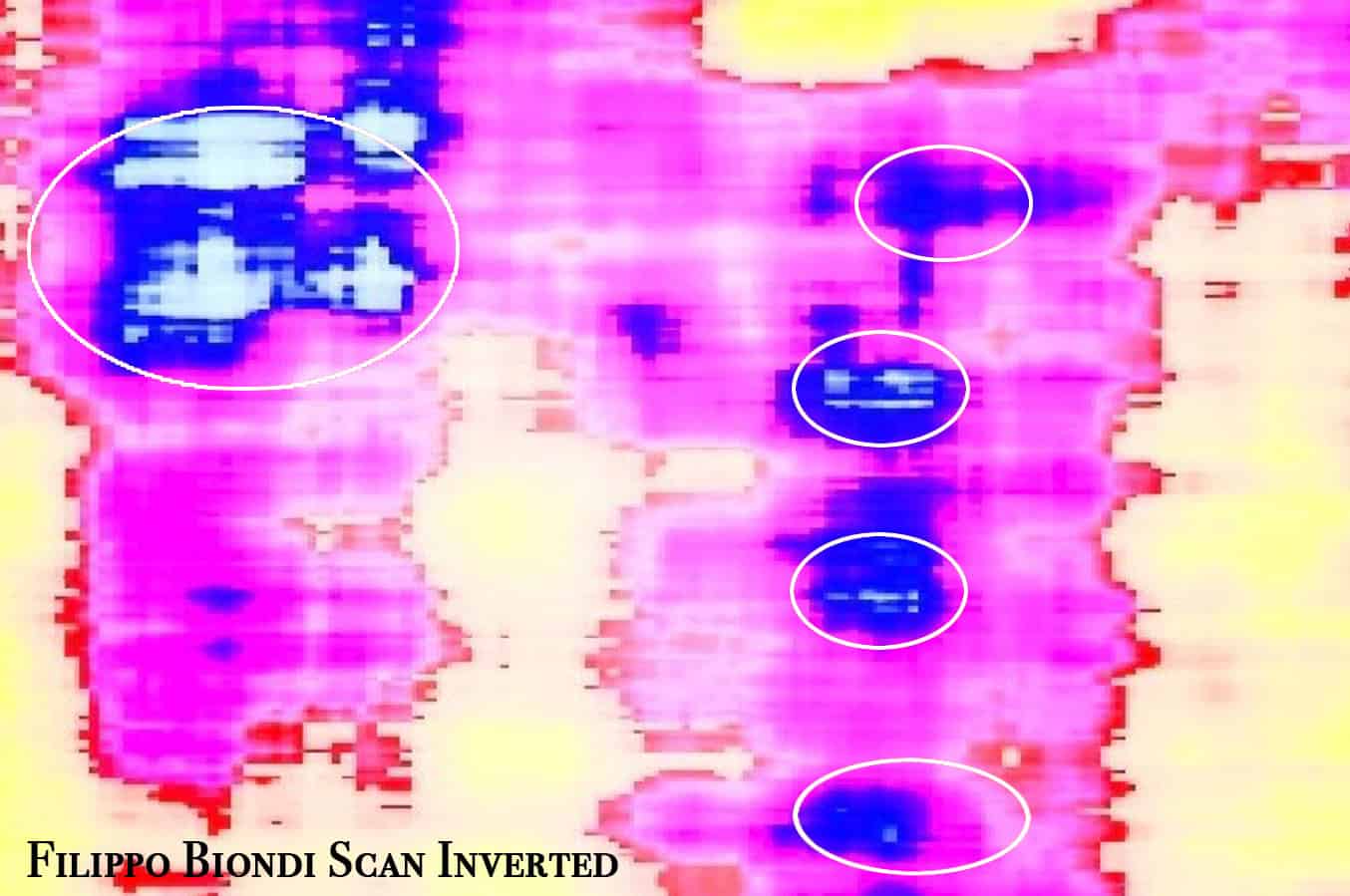
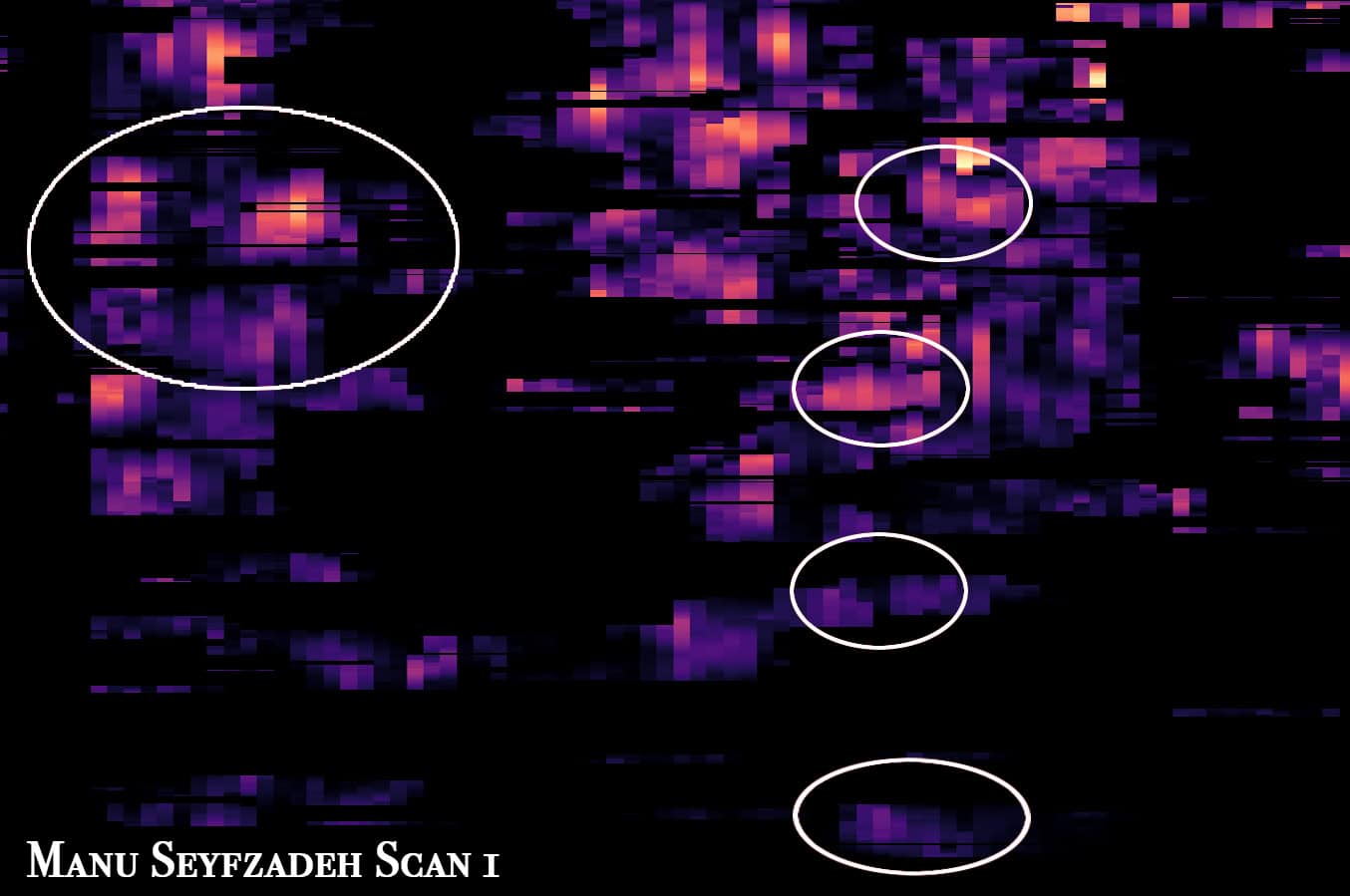
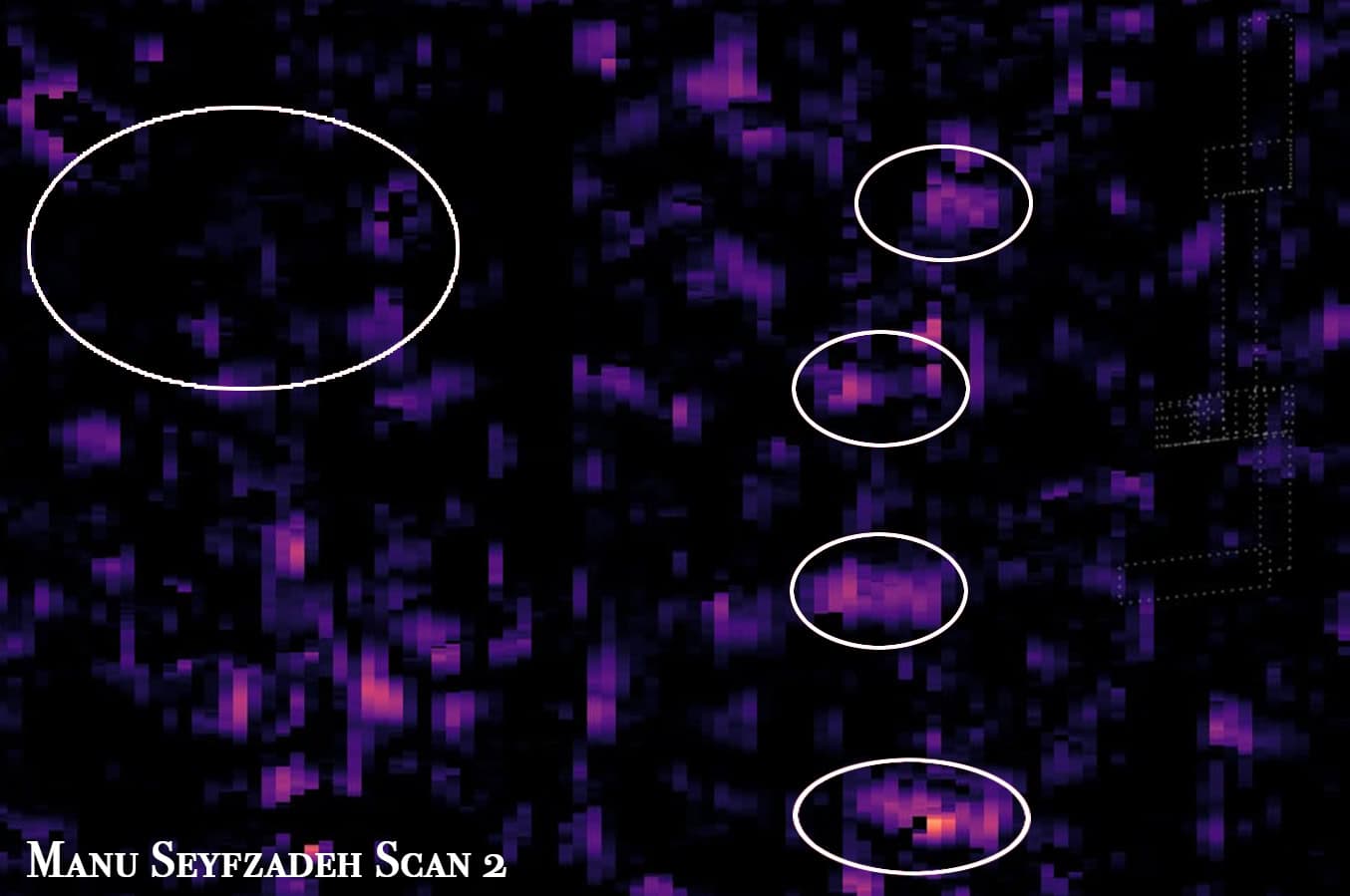
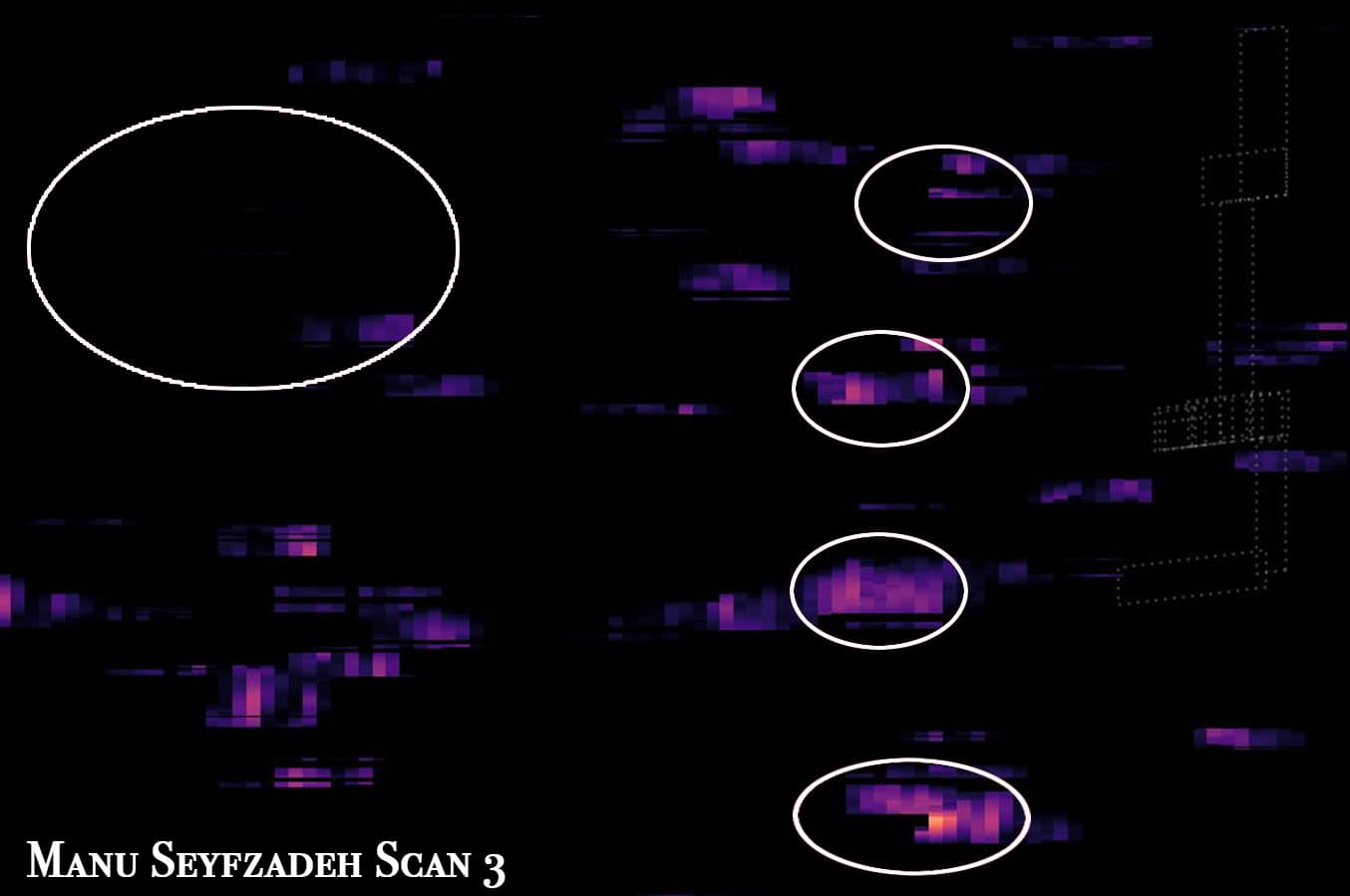
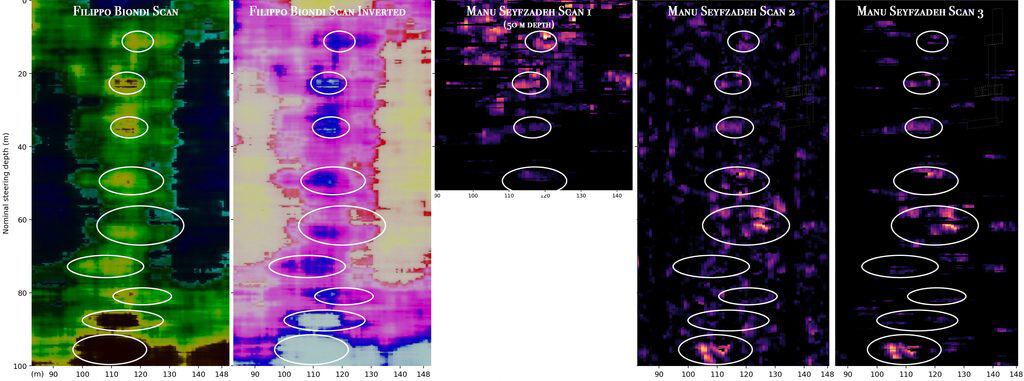
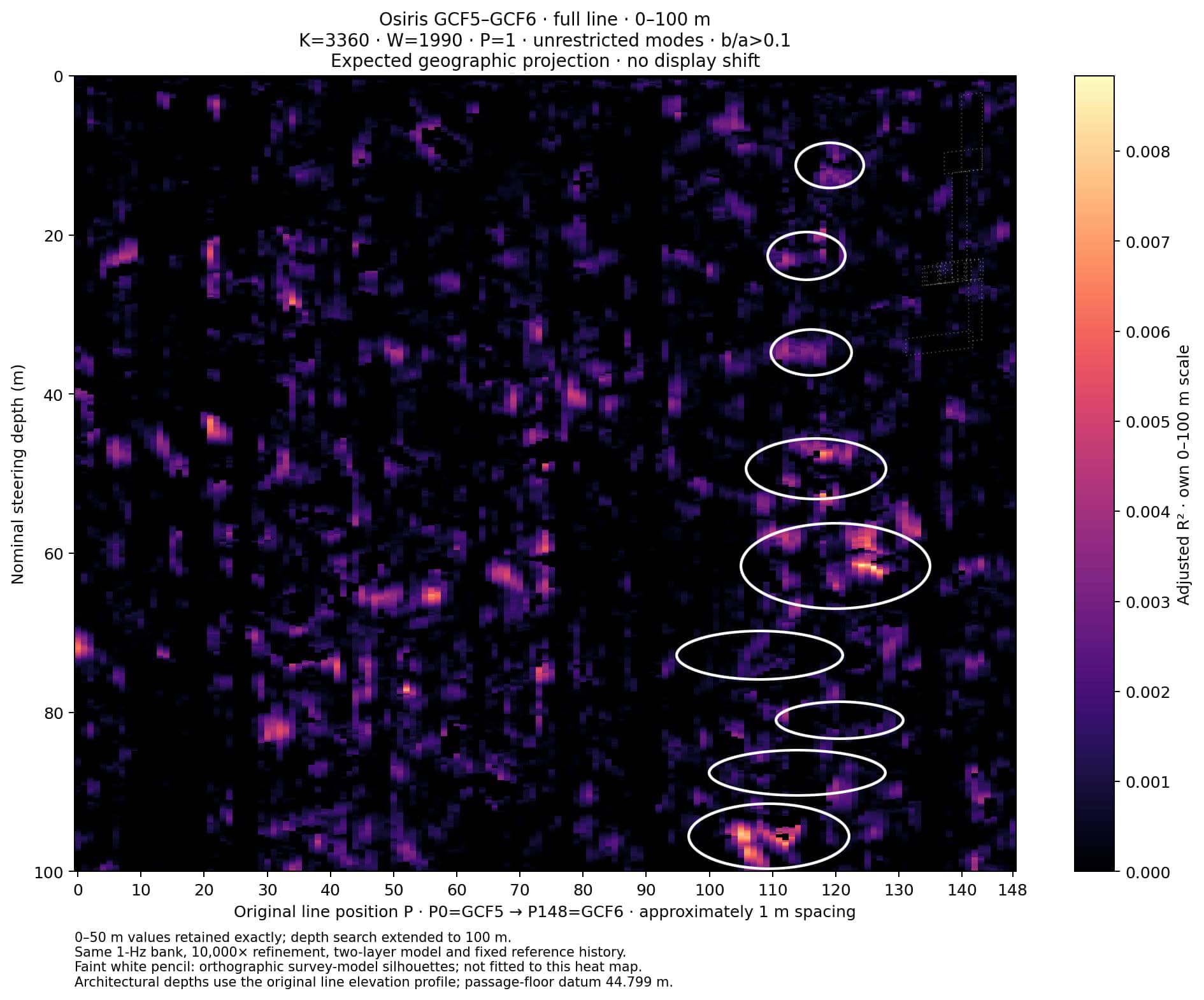
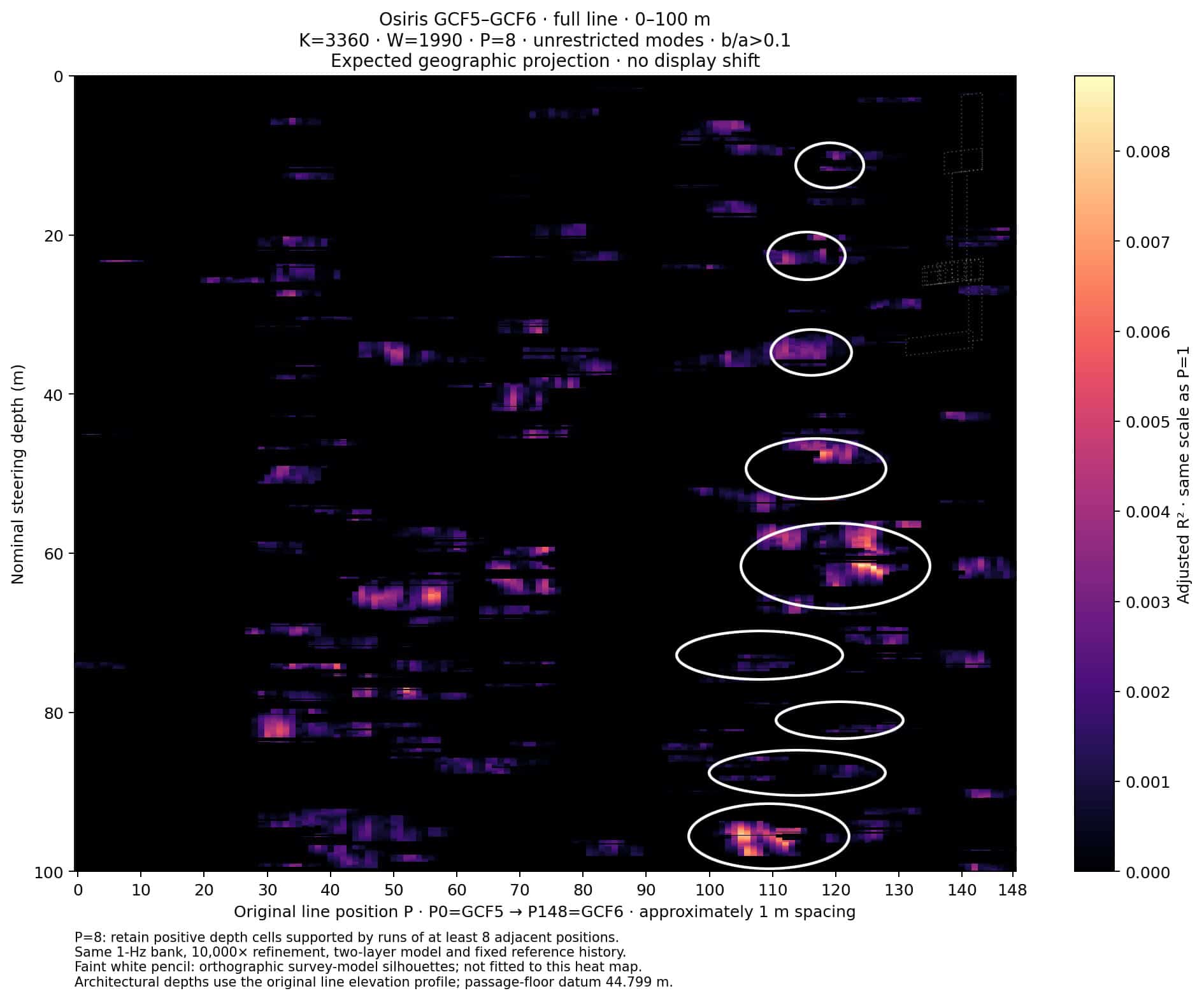
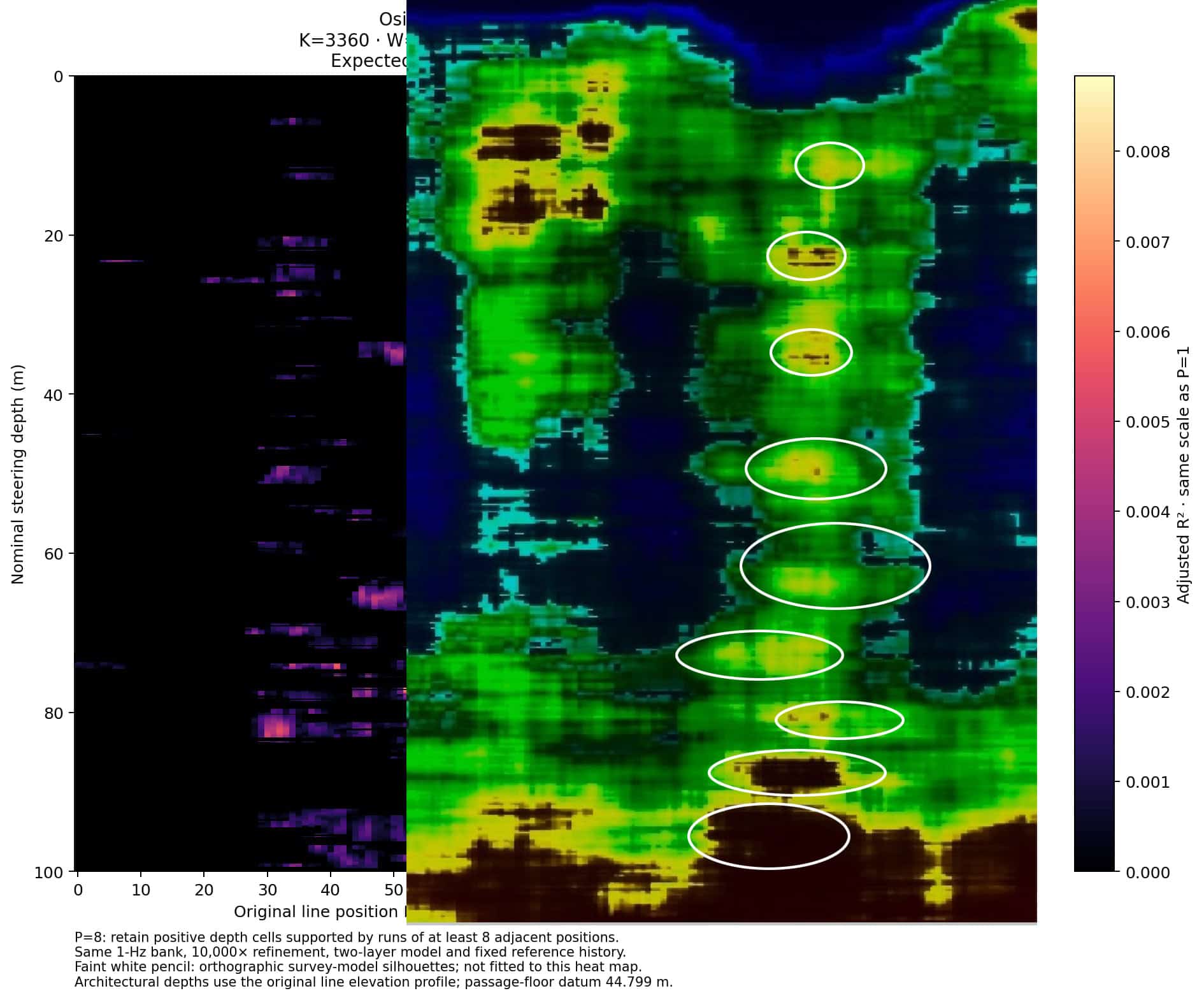
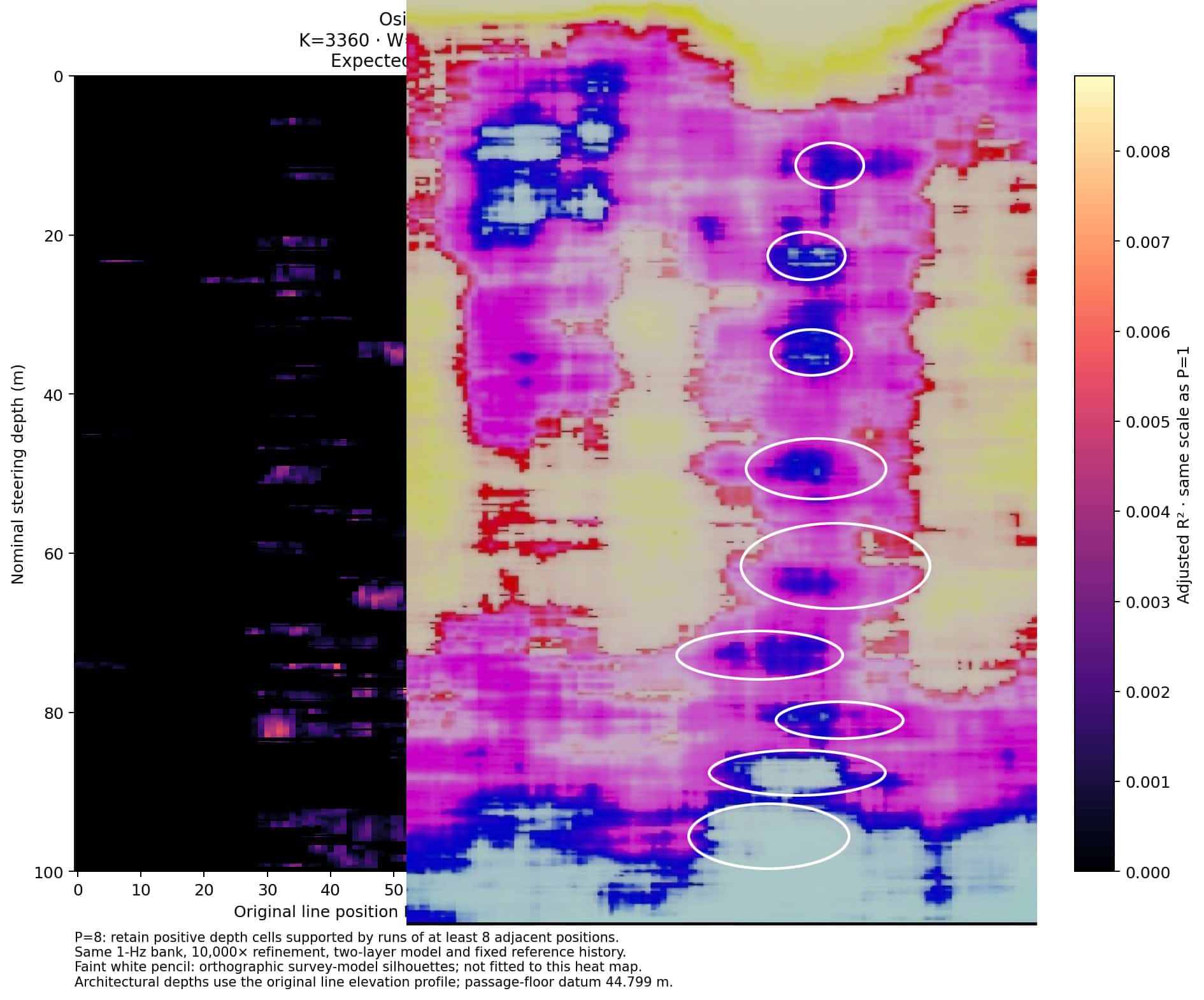
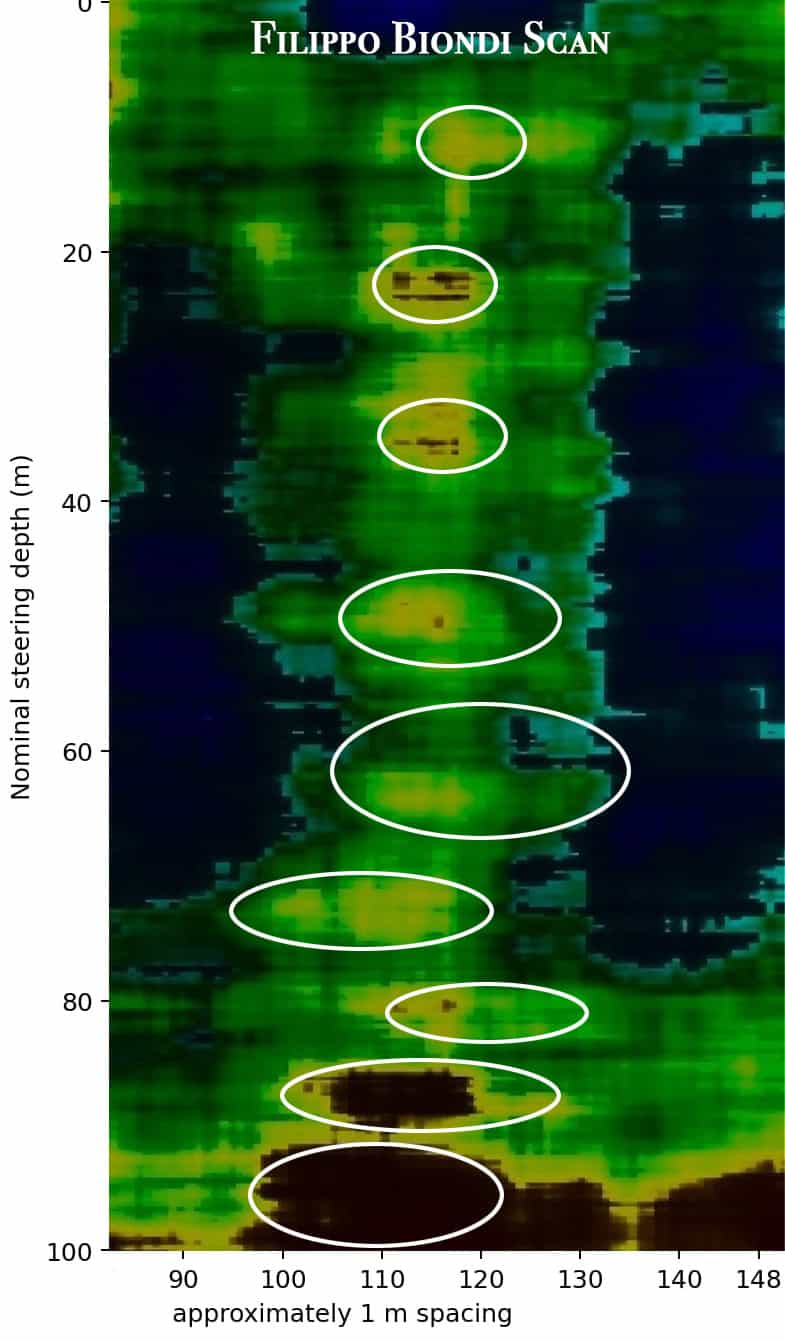
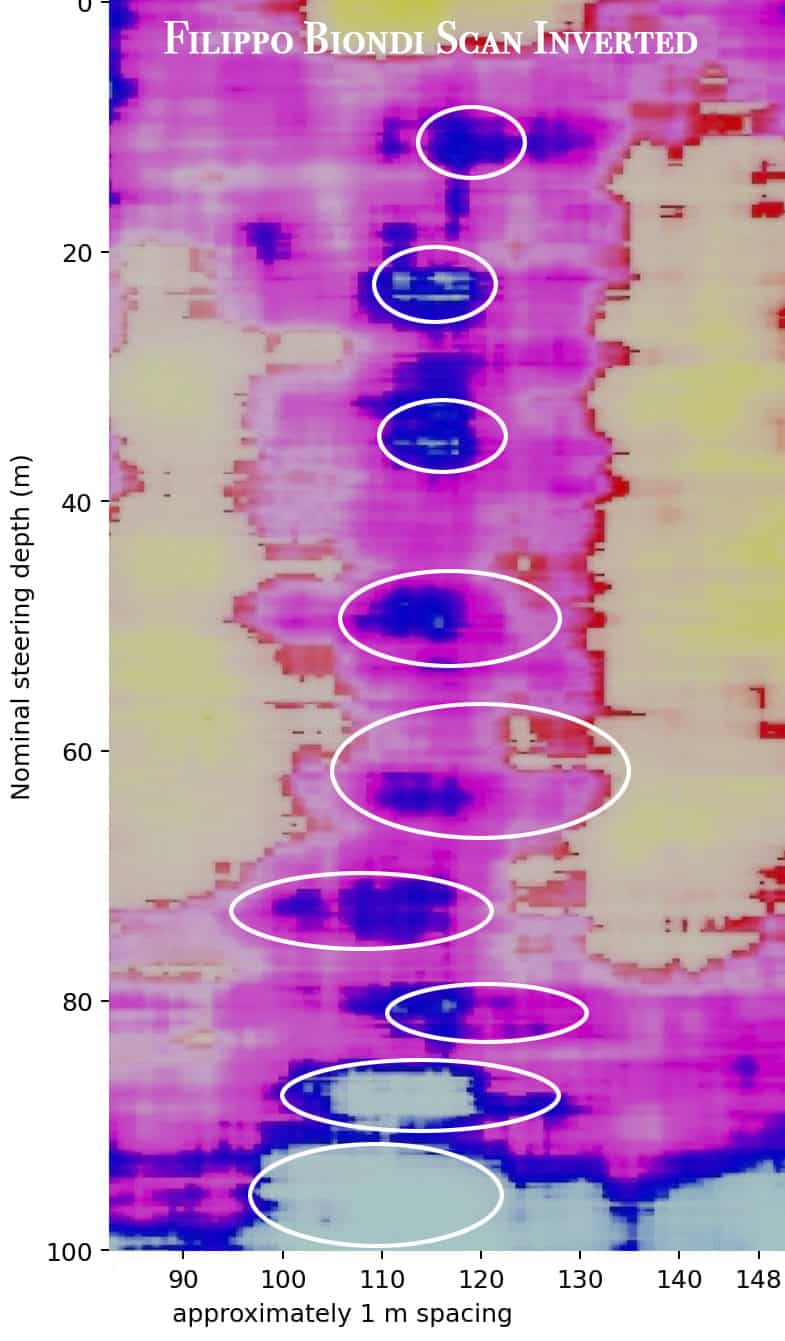
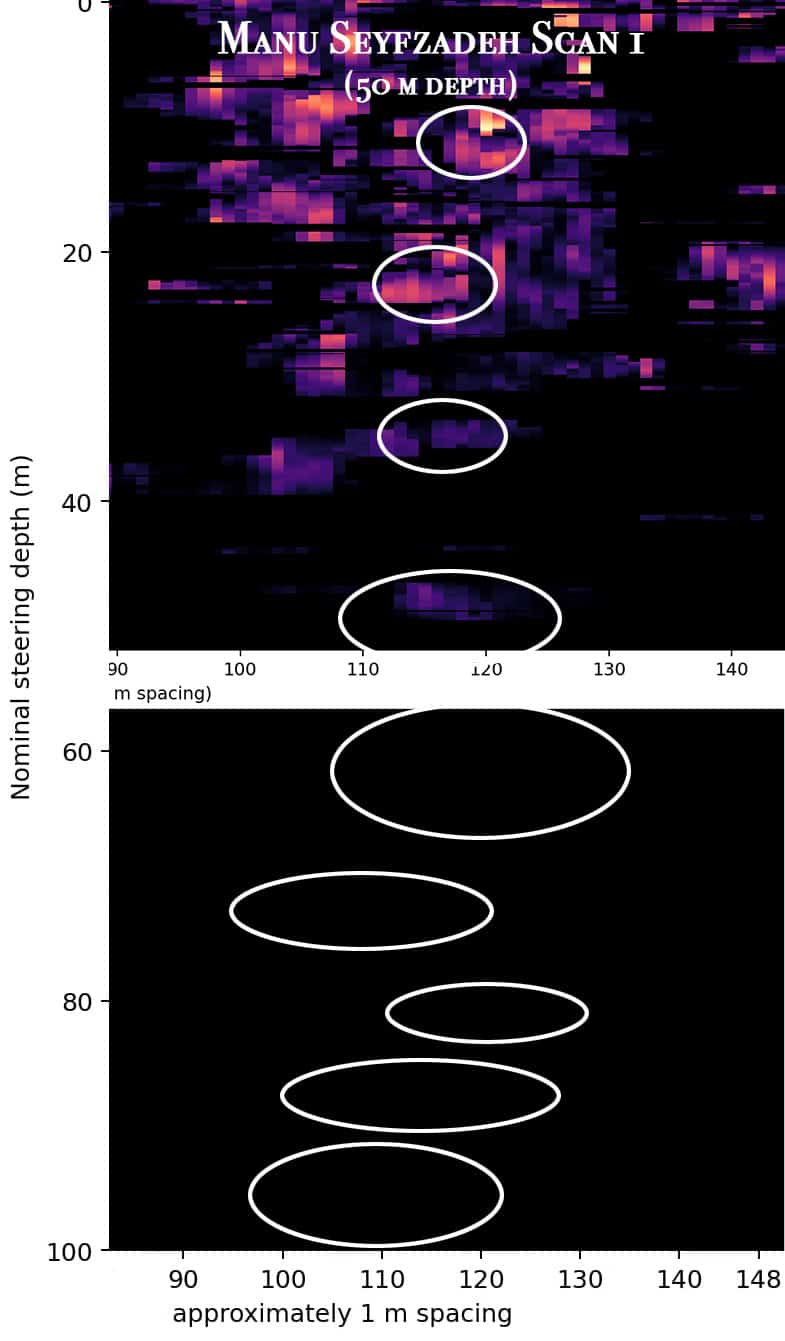
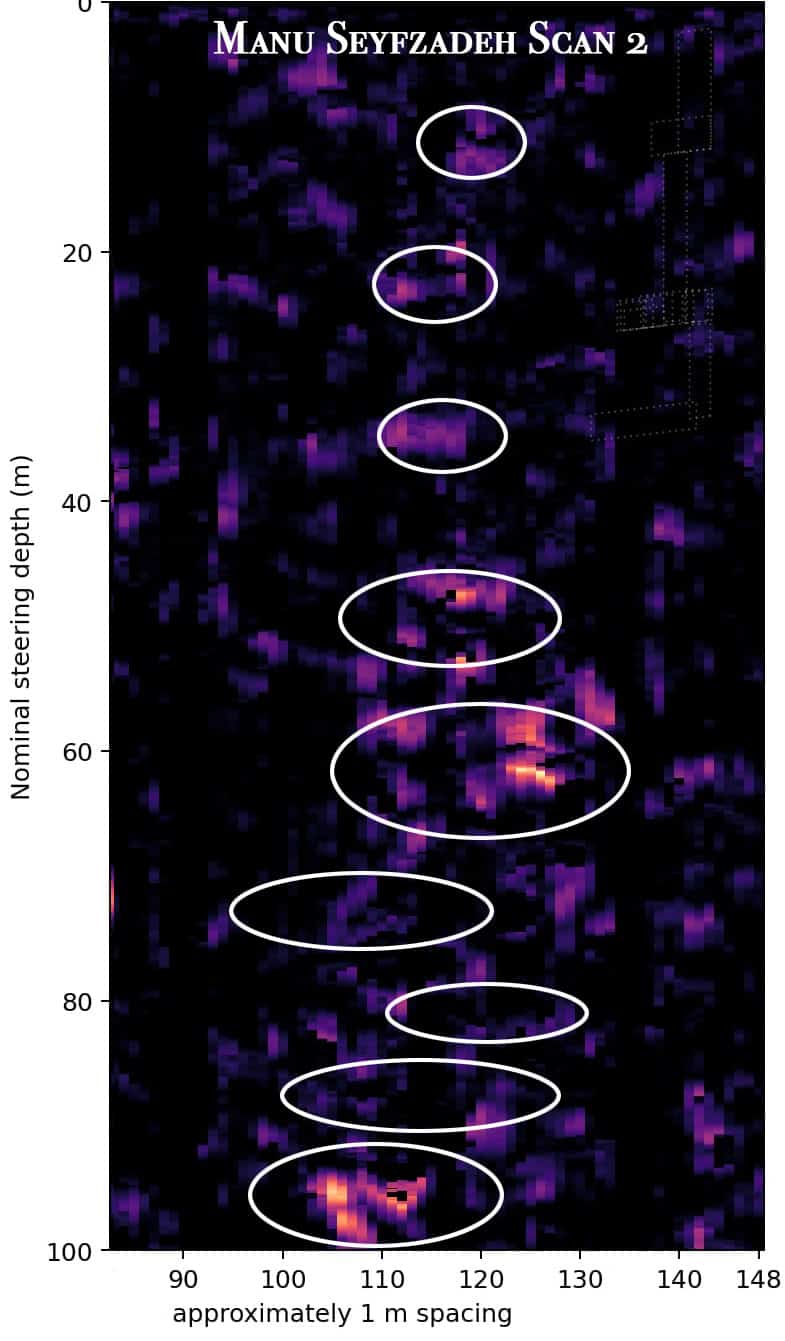
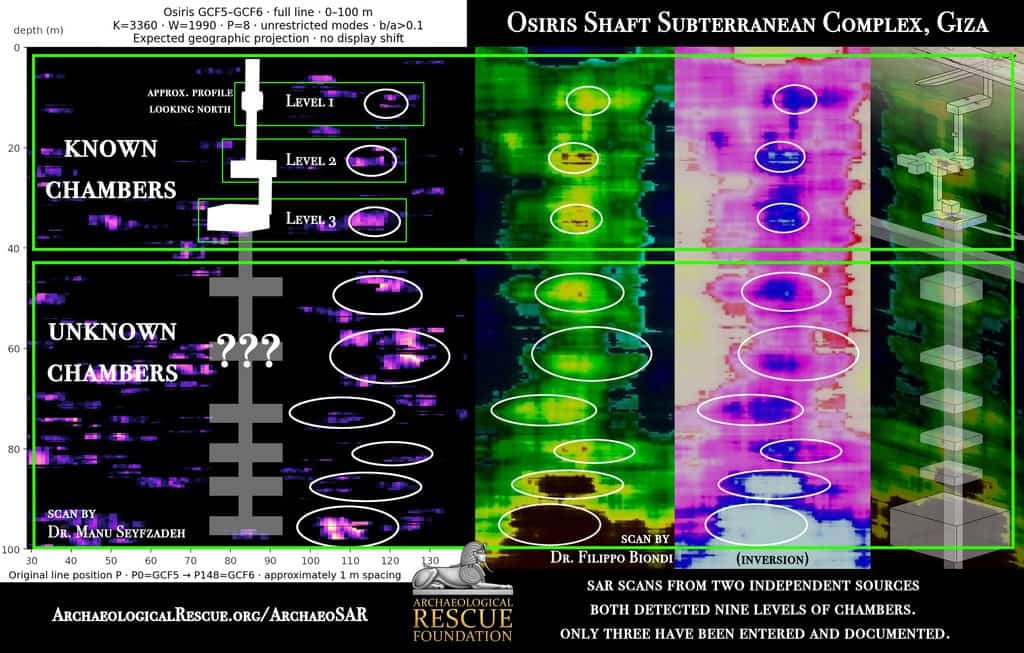
We then moved on to scans with much clearer correlations, targetting the Osiris Shaft; the deepest known accessible location on the whole Plateau. The images below demonstrate that Manu was able to detect the very same three levels of known chambers, and six or more levels below that, of previously unknown chambers, that Biondi had detected. Manu also provided a free 3D model of the known three levels, which he constructed to aid his analysis.
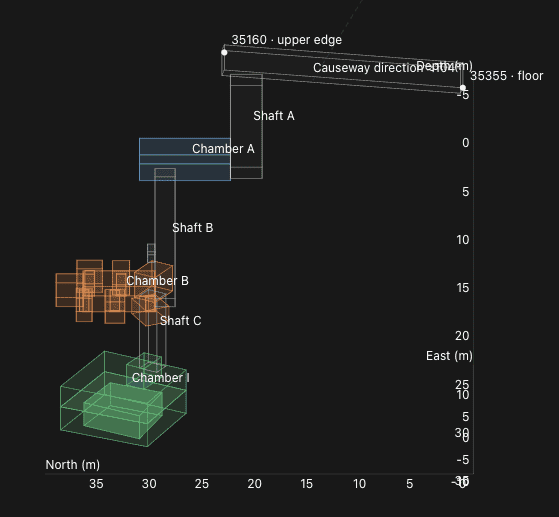
Osiris Shaft Interactive 3D model, by Dr. Manu Seyfzadeh (free download!):
Below is the original high resolution scan from the Khafre Project:
Here is its inversion, making some of the chamber locations easier to visualize:
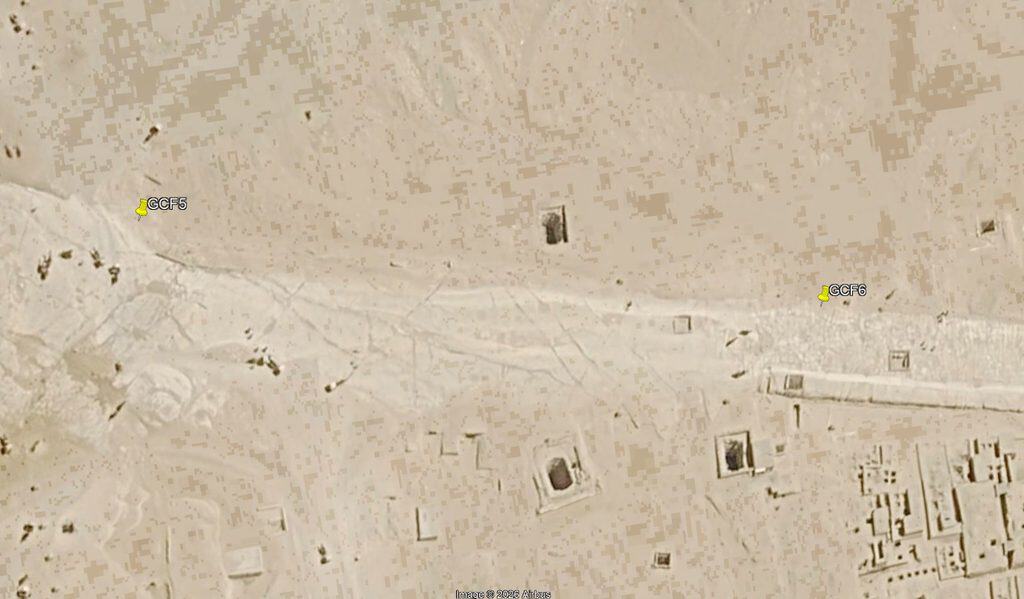
These are the two end points of the tomographic line surveyed by Manu:
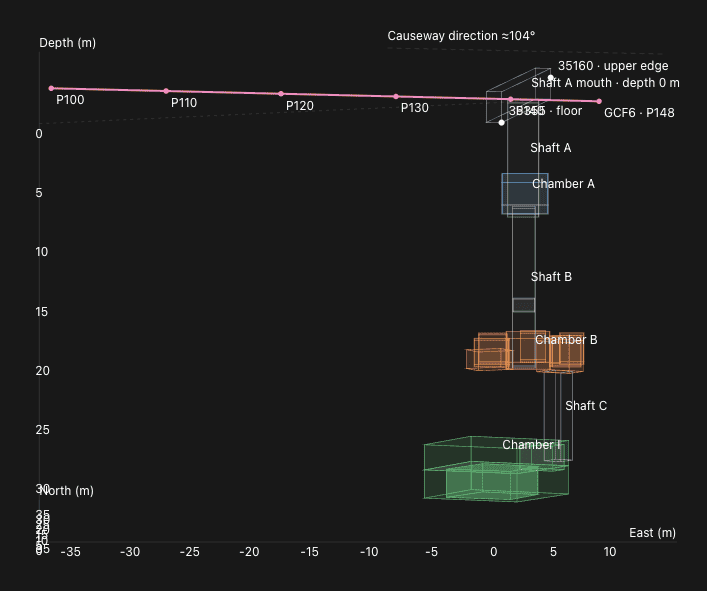
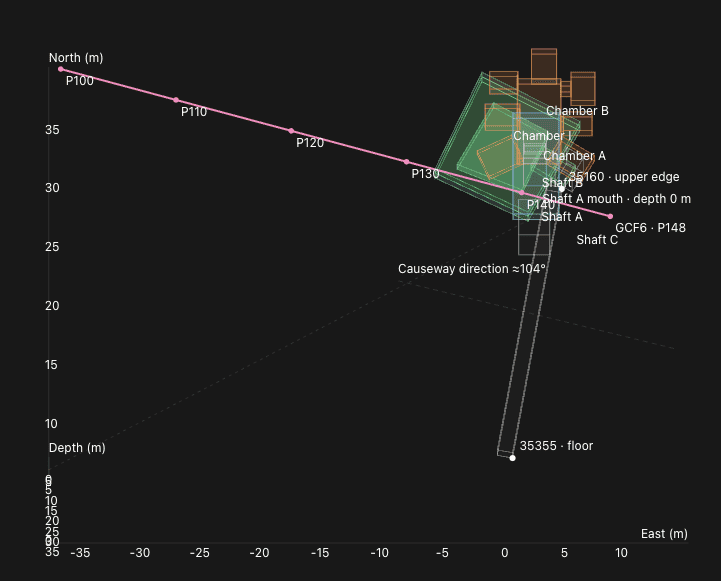
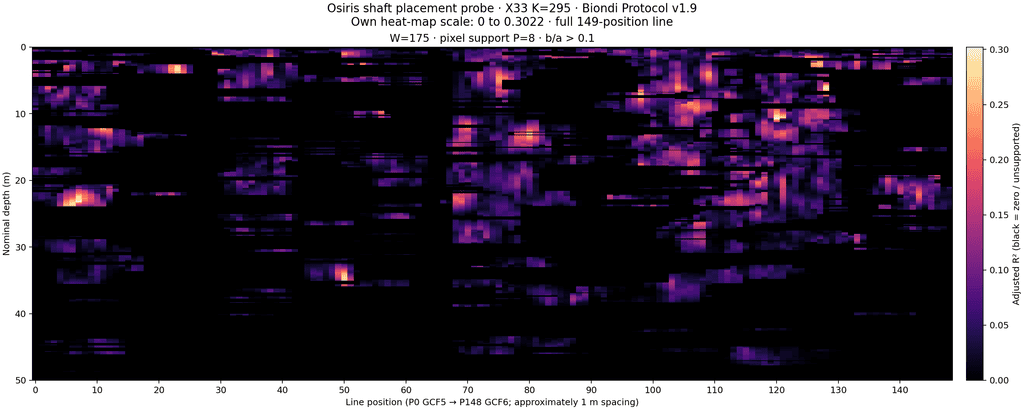
SCAN 1
… was 150 meters long, first scanned with a low resolution, to 50 m depth.
SCAN 2
Using the same line, this scan went 100 meters deep at a much higher resolution. Manu included an approximation of the three chambers’ outline to their right, for reference.
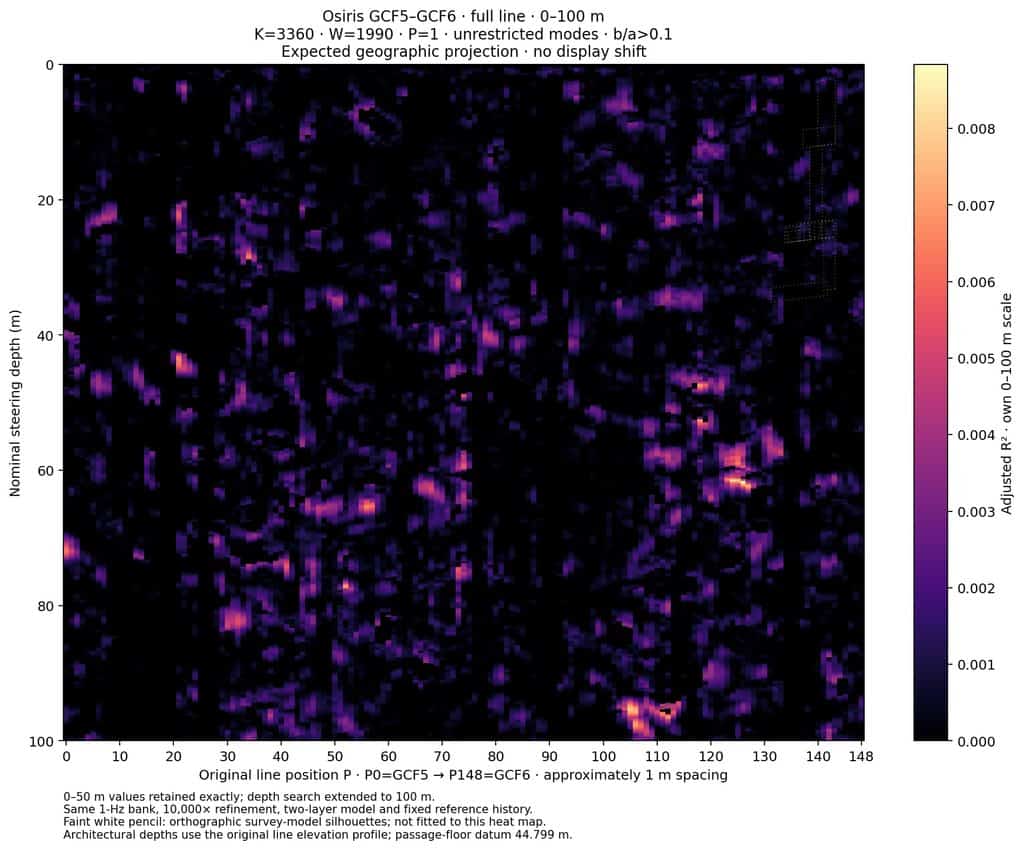
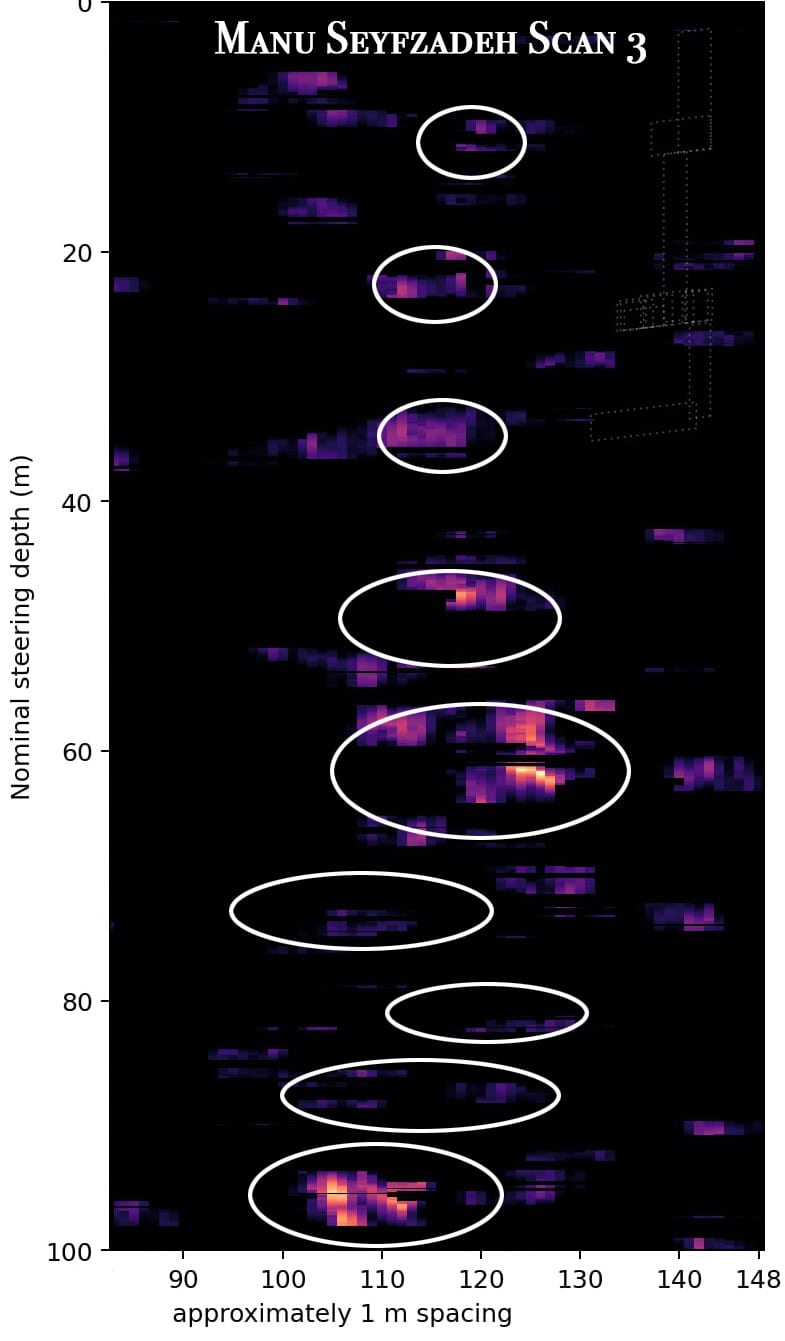
Scan 3
This time, to reduce the background noise, Manu applied a heavier filter, but kept the higher resolution and 100 meter depth.
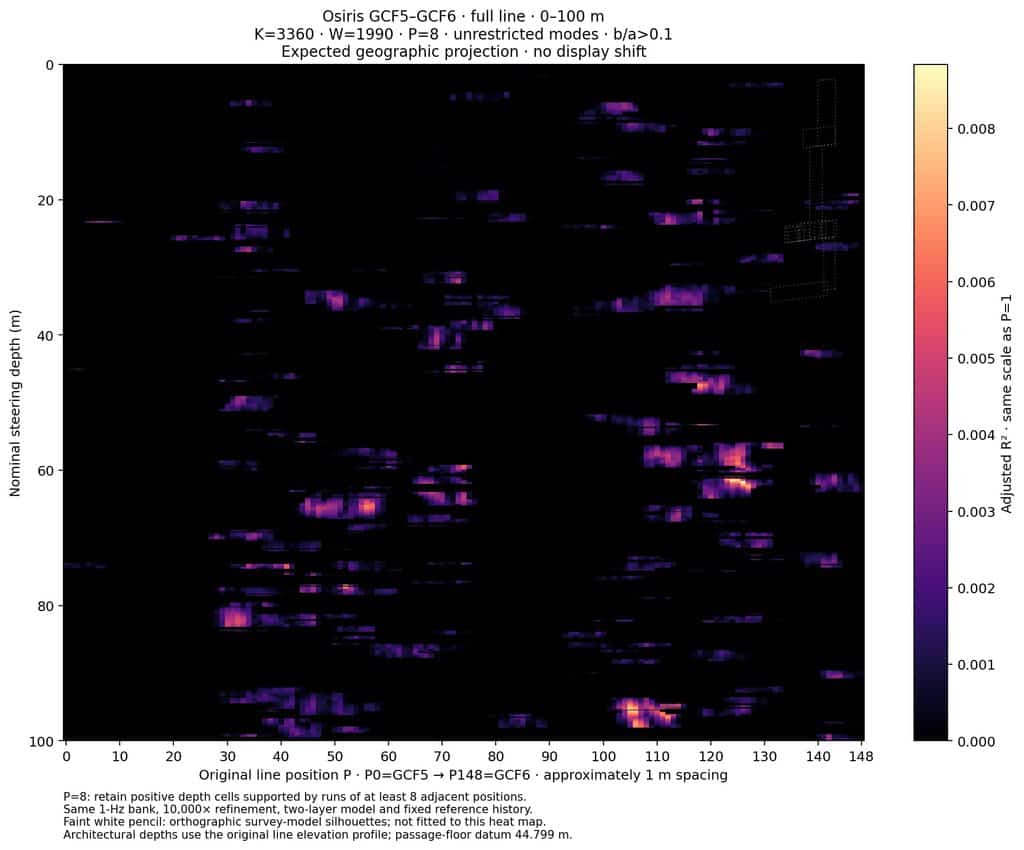
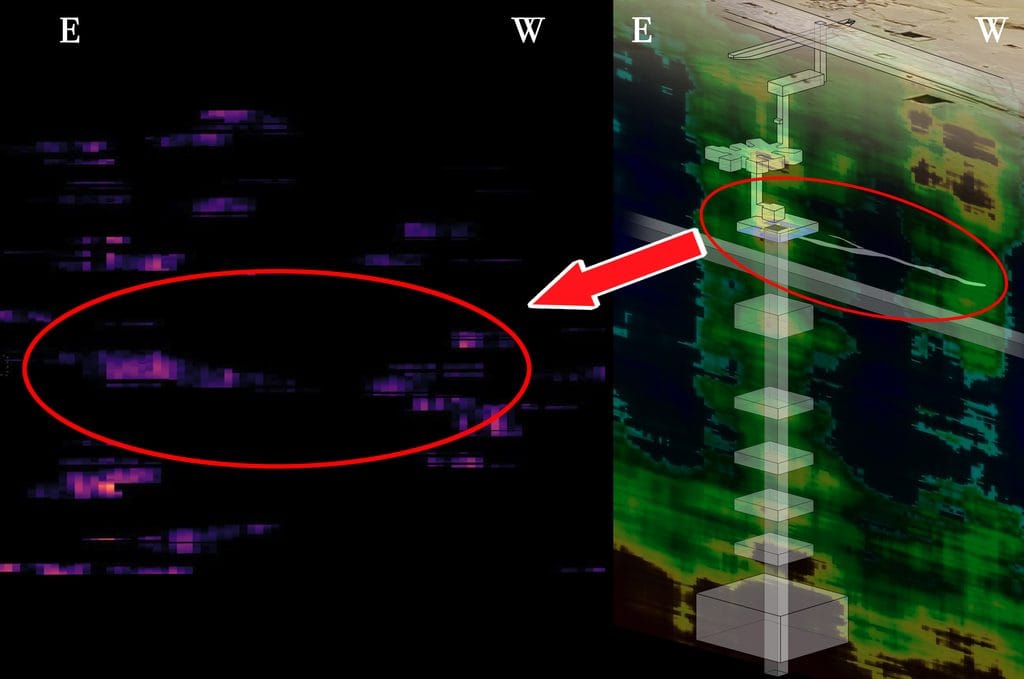
The comparisons are shown here:
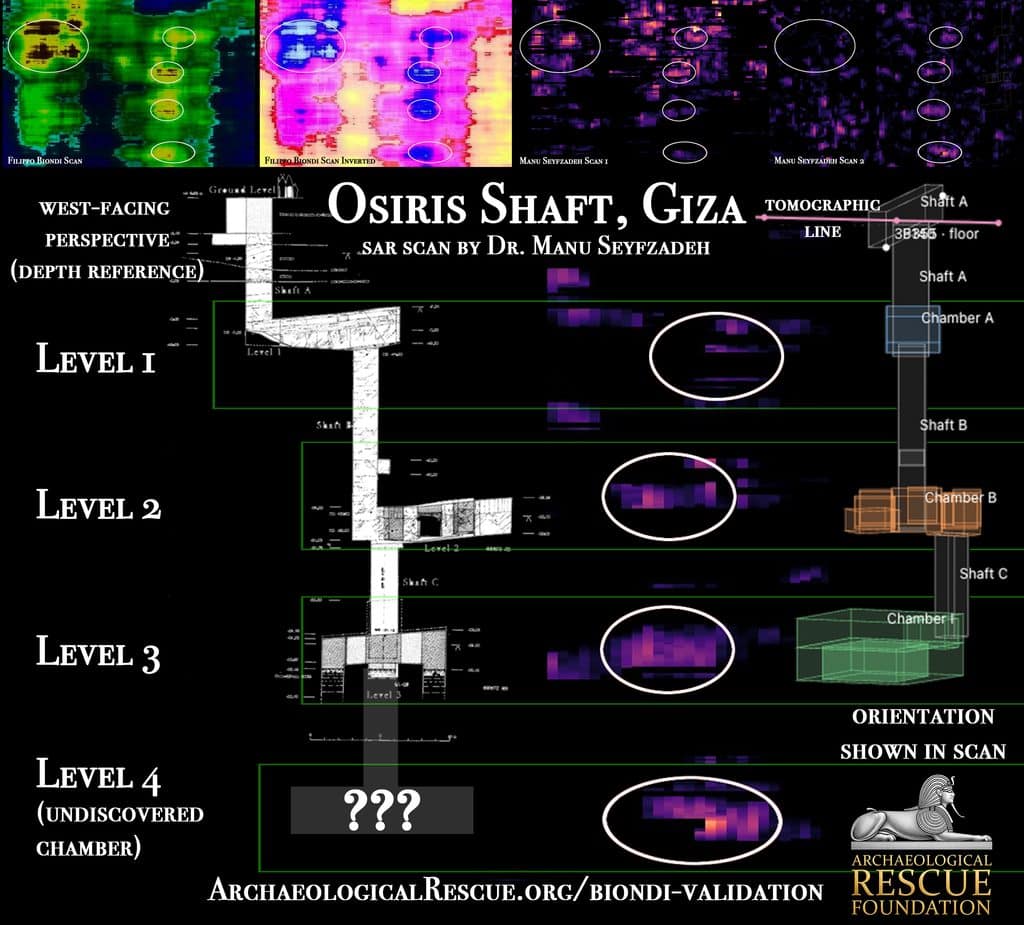
Western Cemetery Control Test
On May 5, 2024, a paper was published under the title, GPR and ERT Exploration in the Western Cemetery in Giza, Egypt. This report details the results of subsurface scanning using Ground Penetrating Radar and Electrical Resistivity Tomography. Manu used this data as a control, in order to test his method against the GPR and ERT results. These are two of the most trusted and well established methods for remote sensing on the ground, so if the results match what his SAR scans pick up, the method is effectively proven against the known industry standard.
His results did indeed, once again, match perfectly!
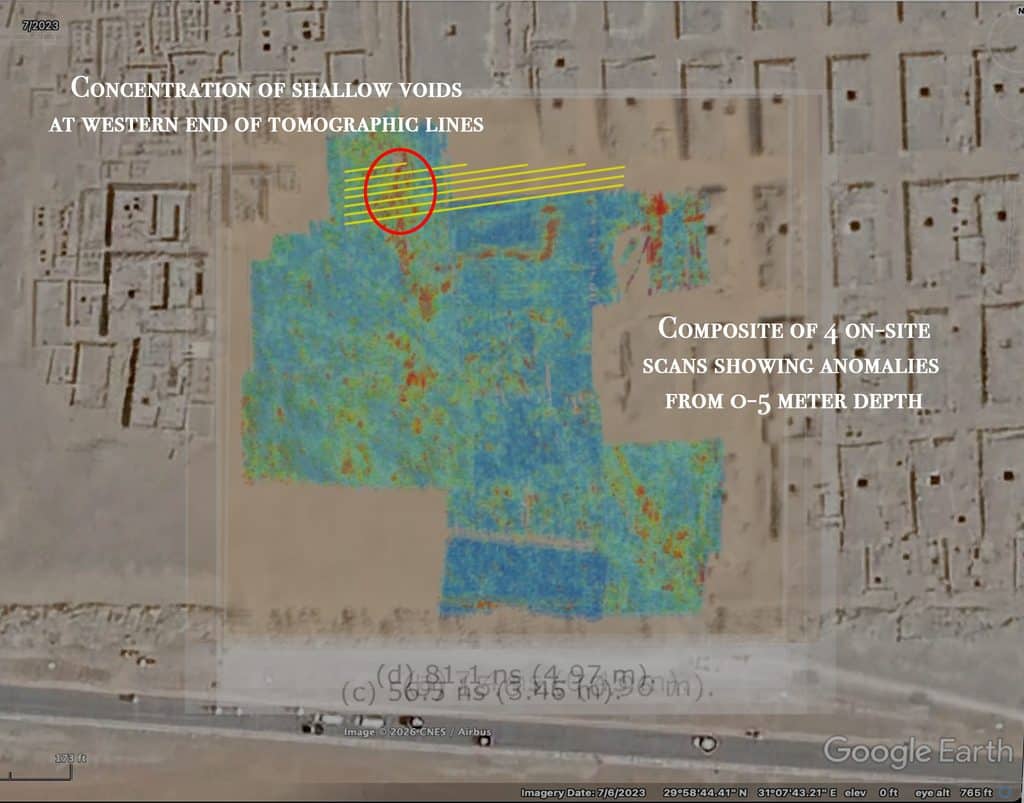
The paper included four scan images showing distinct levels of anomalies in a range from approximately .5 – 5 meters in depth.
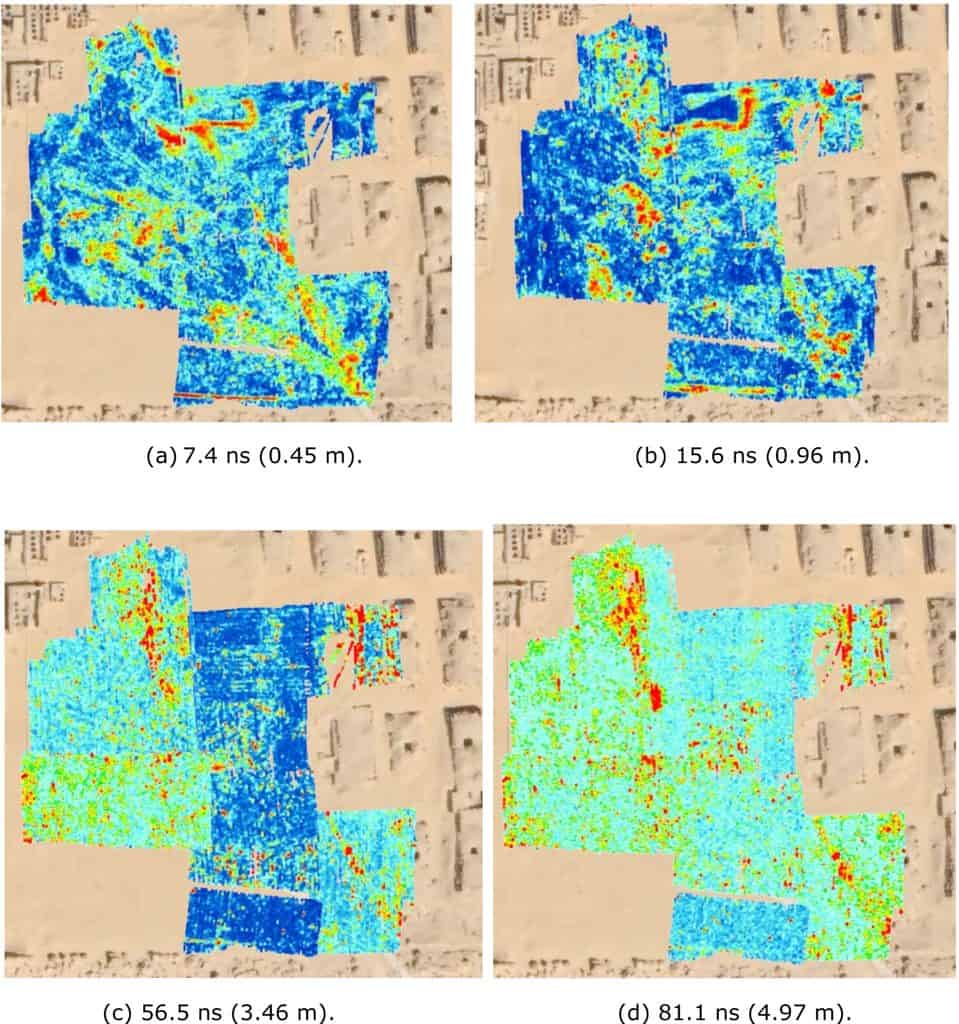
I aligned these four images in photoshop and reduced their opacities to 25%, allowing us to see an aerial view of all four layers at once.
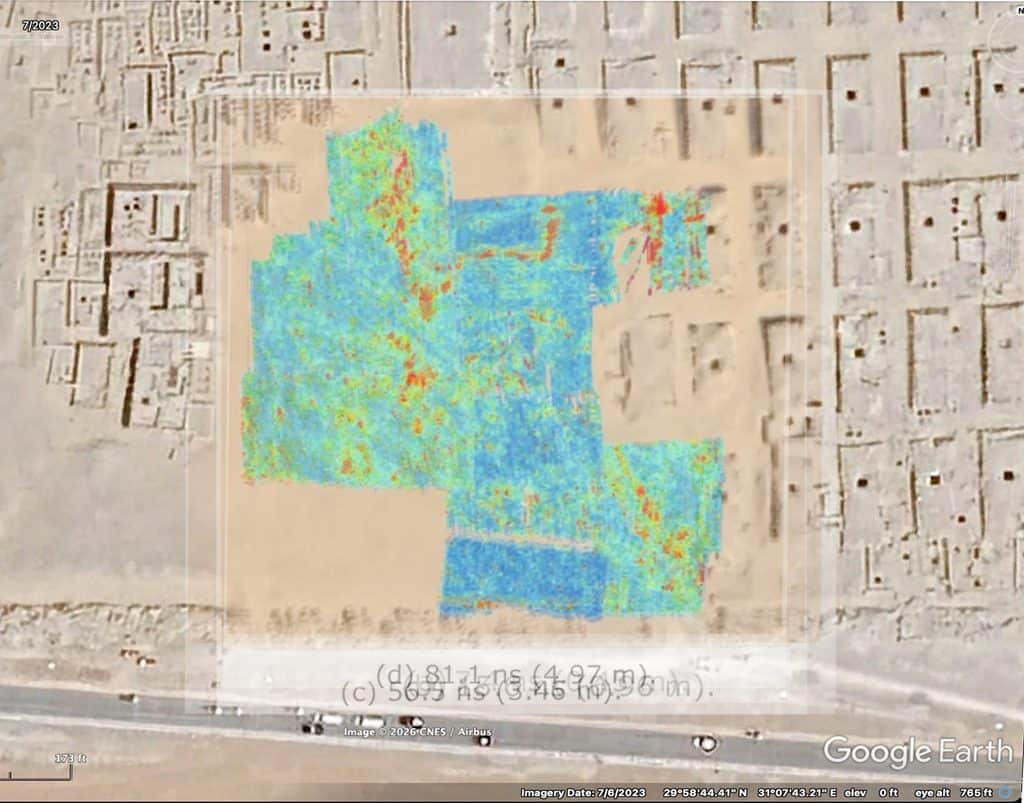
I then illustrated the exact placement of seven tomographic lines surveyed by Manu Seyfzadeh. They span the Northern end of the target zone, notably crossing a large section of anomalies on their western ends.
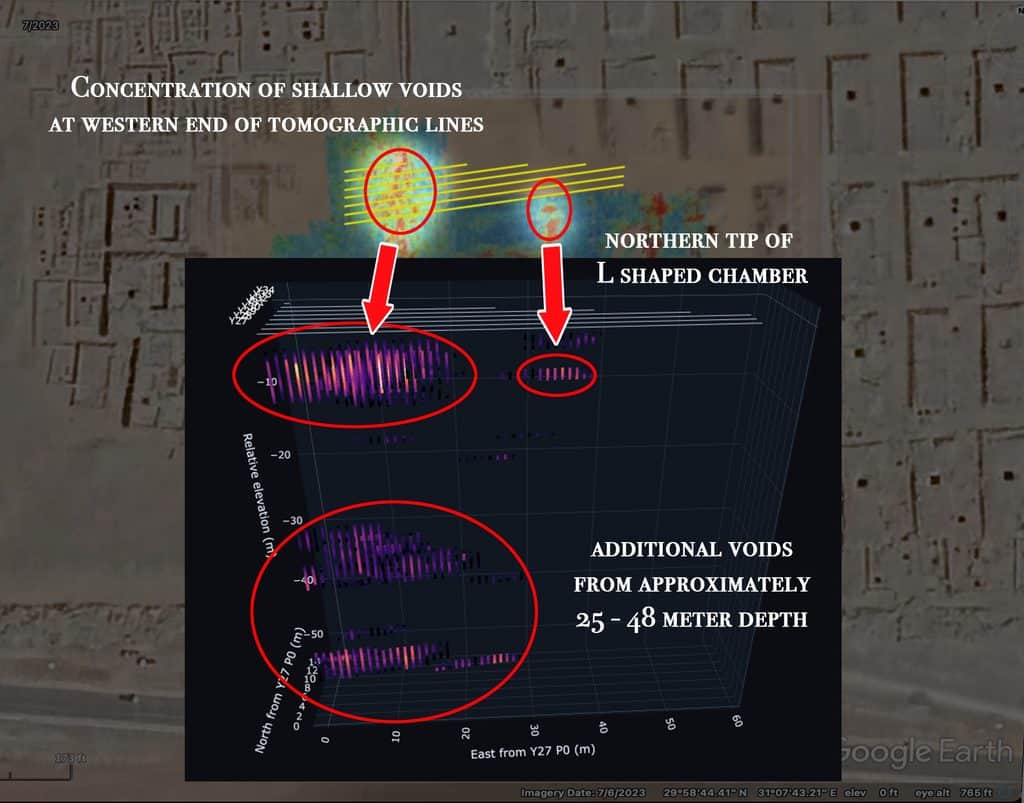
The anomalies registered perfectly in Manu scans, and beyond that, he was able to align all the scans into a 3D model with all the negative space deleted, allowing a complete view of the anomalies from every perspective. You can rotate the model yourself, as Manu has also given me permission to share the model itself.
Not only does it register the anomalies expected on the Western end, but it also picked up additional anomalies directly below them, at a depth ranging from 25 – 48 meters! These are voids that have never been detected by anyone before! Additionally, it also caught the north end of the ‘L-shaped’ that the Japanese team had discovered.
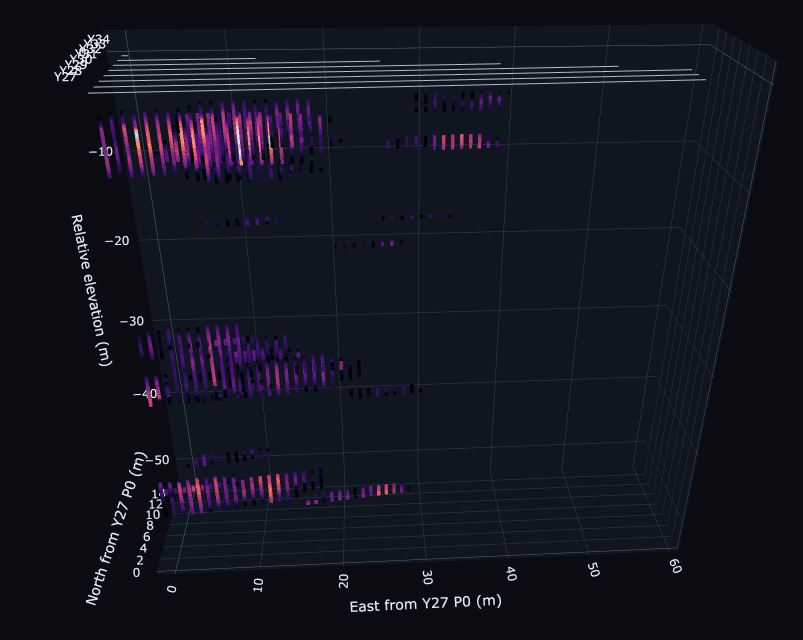
Manu plans to continue this experiment by surveying additional lines that cover more of the surveyed area. We will report more of his progress in the future, and we plan to freely share this data with the ground team.
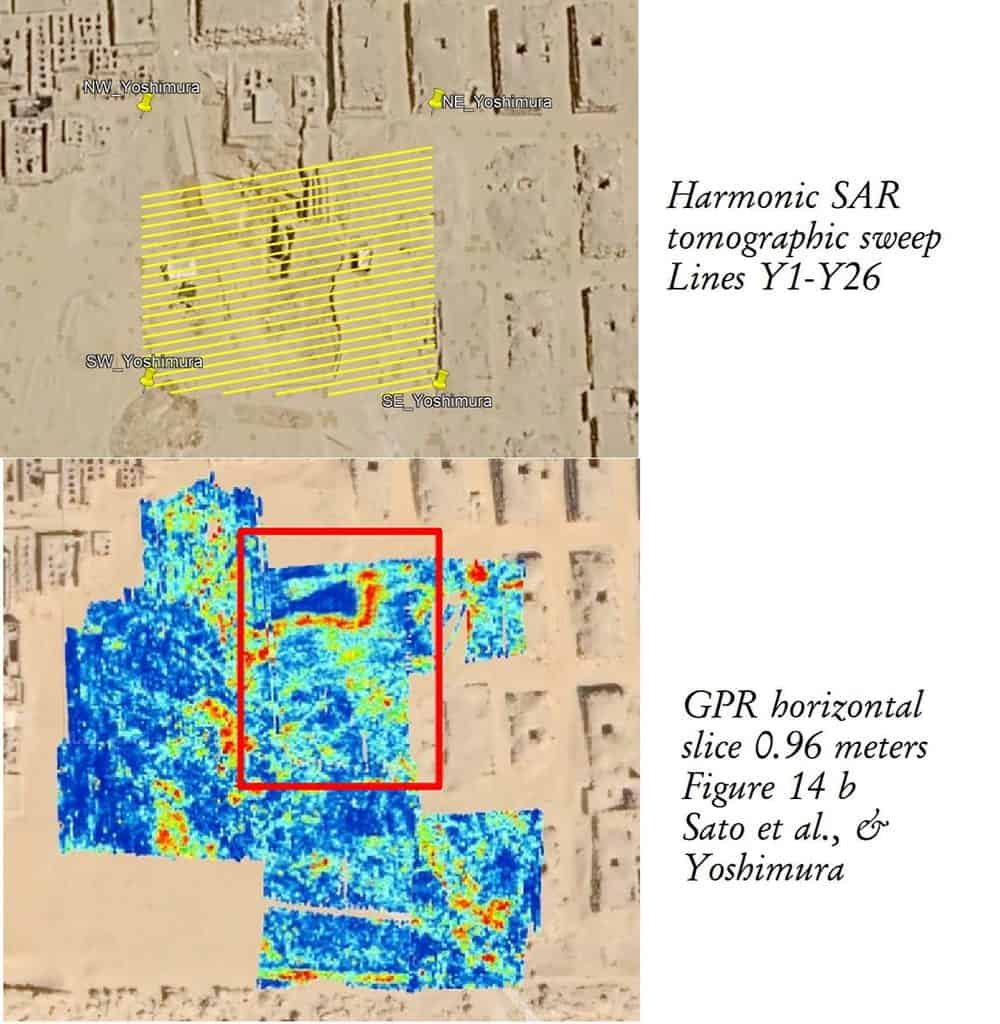
This represents yet another absolutely successful control test. In a single night, from the comfort of his own home, Manu created a model that is in infinitely more informative than the scan images generated by two years of ERT and GPR teams working on site. This is a simple, proven fact, that fundamentally alters the future of Archaeology, not to mention, countless other fields and industries.
Great Pyramid Control Test
Manu also sent me a model showing two scans cutting diagonally down from the Great Pyramid’s East Face. He aligned the two tomograms respectively to the King and Queen’s chambers, hoping to detect them. The scan marked by a yellow line represents the exact center cross section of the pyramid, and therefore, the center of Queen’s Chamber. The scan marked by a blue line is 11 meters south of the pyramid center, to align with the center of the King’s Chamber.
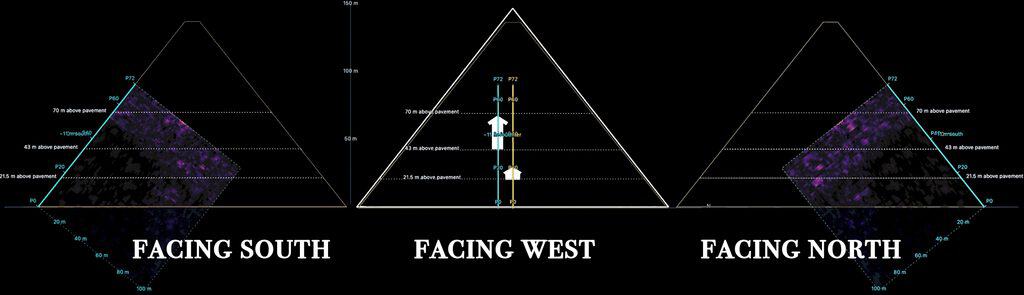
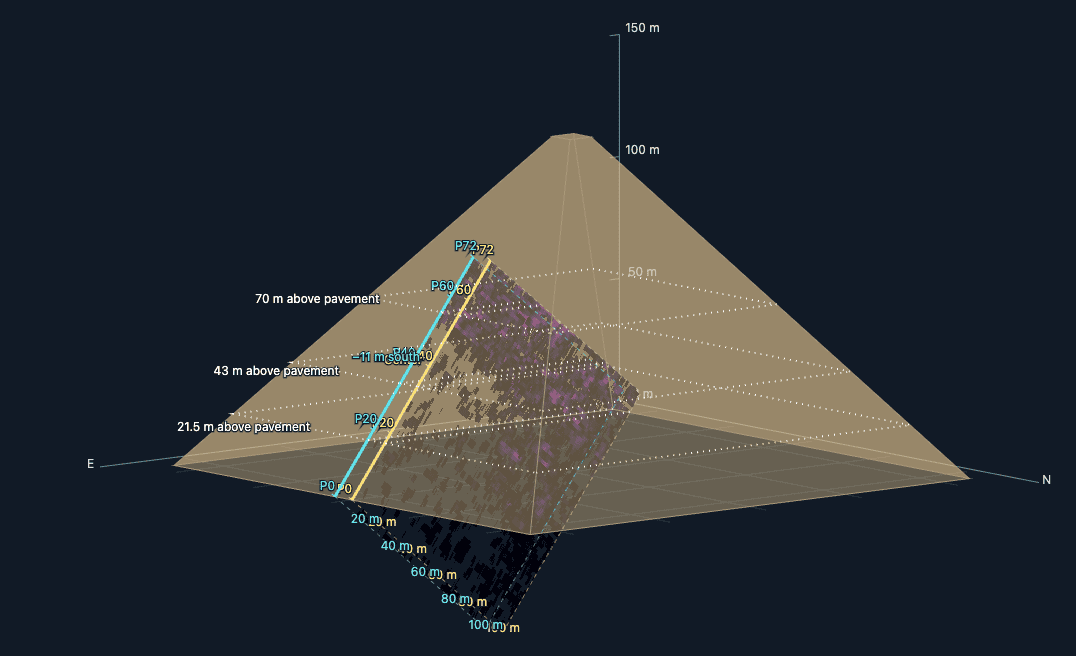
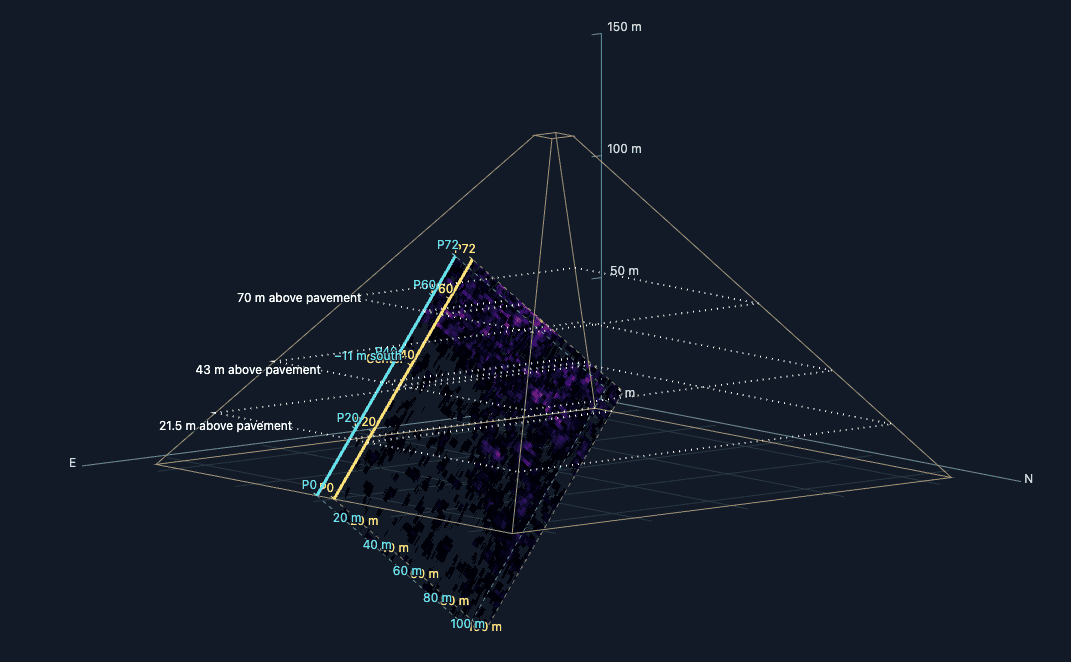
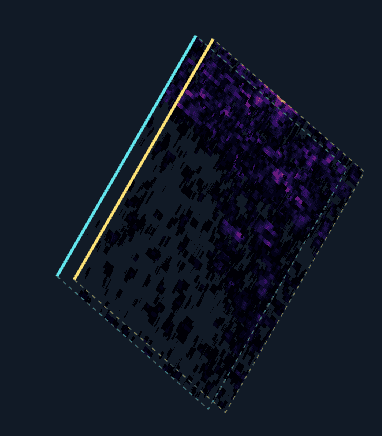
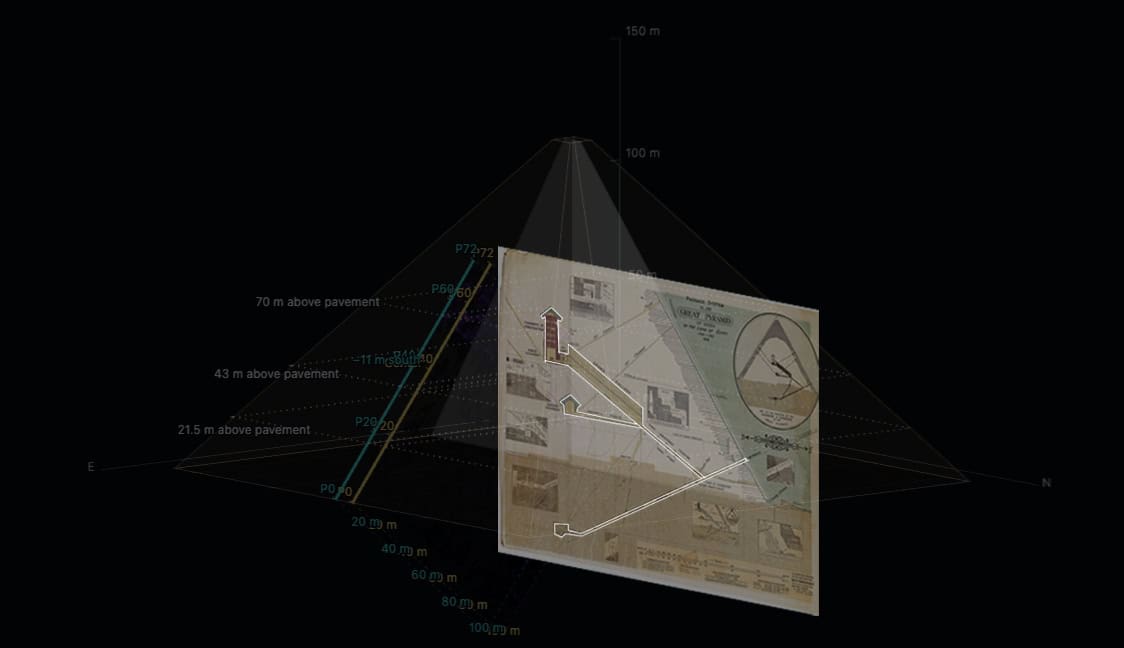
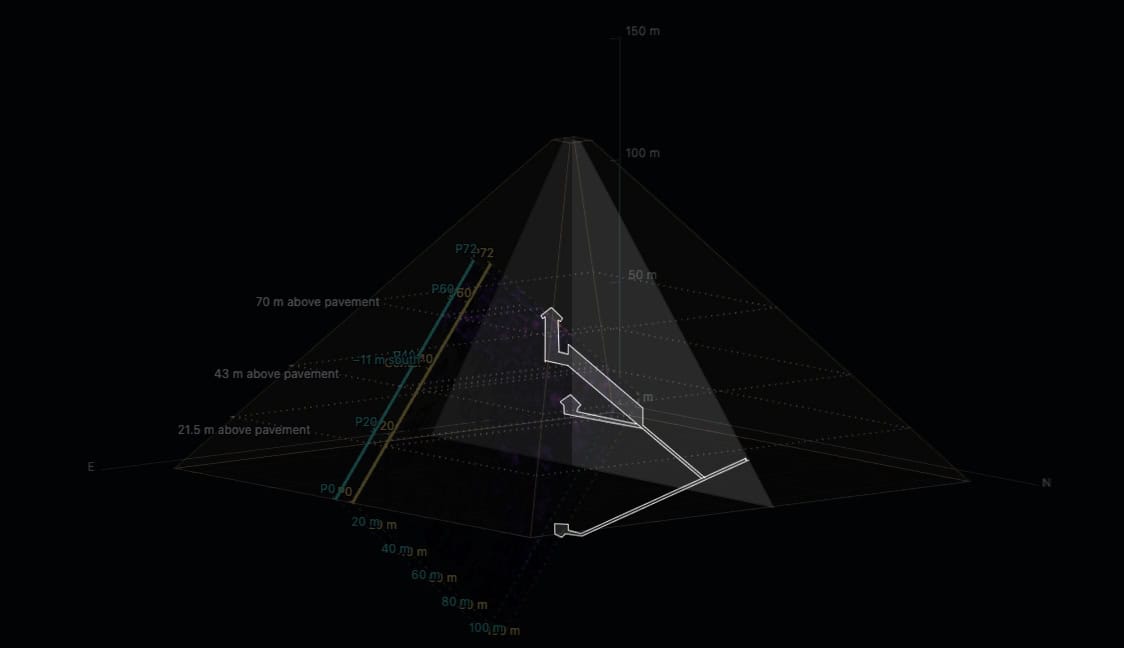
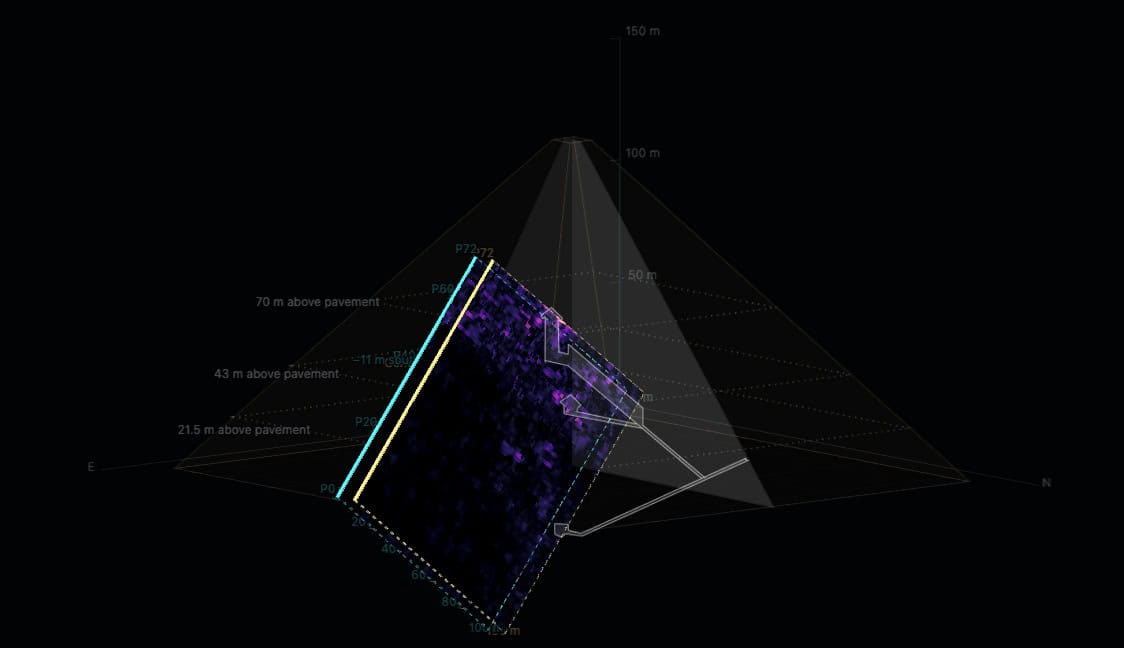
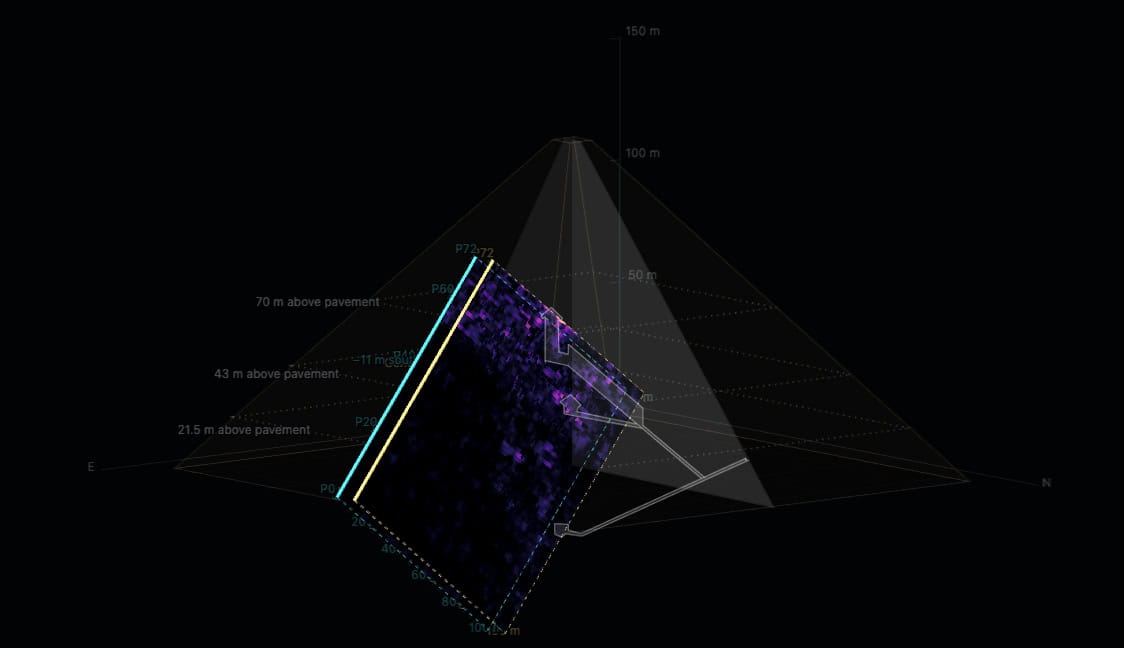
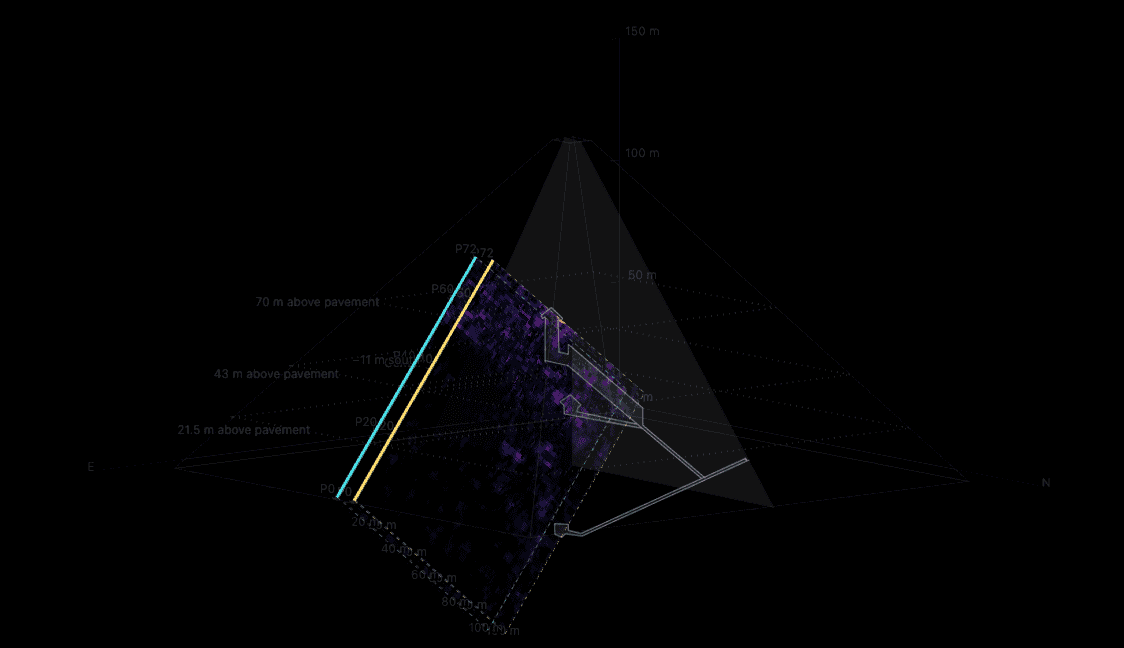
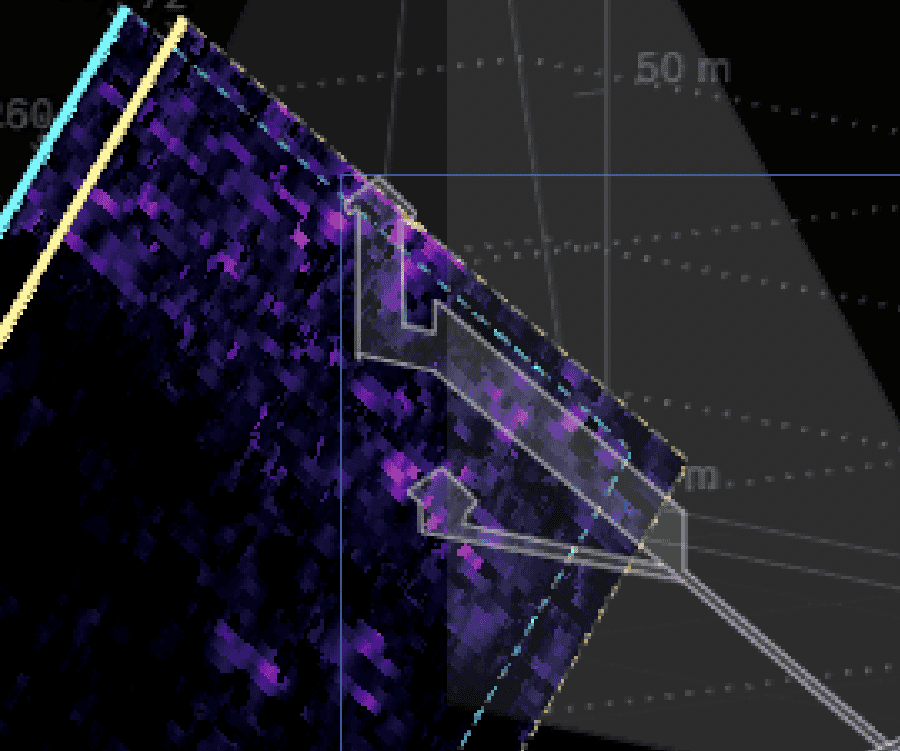
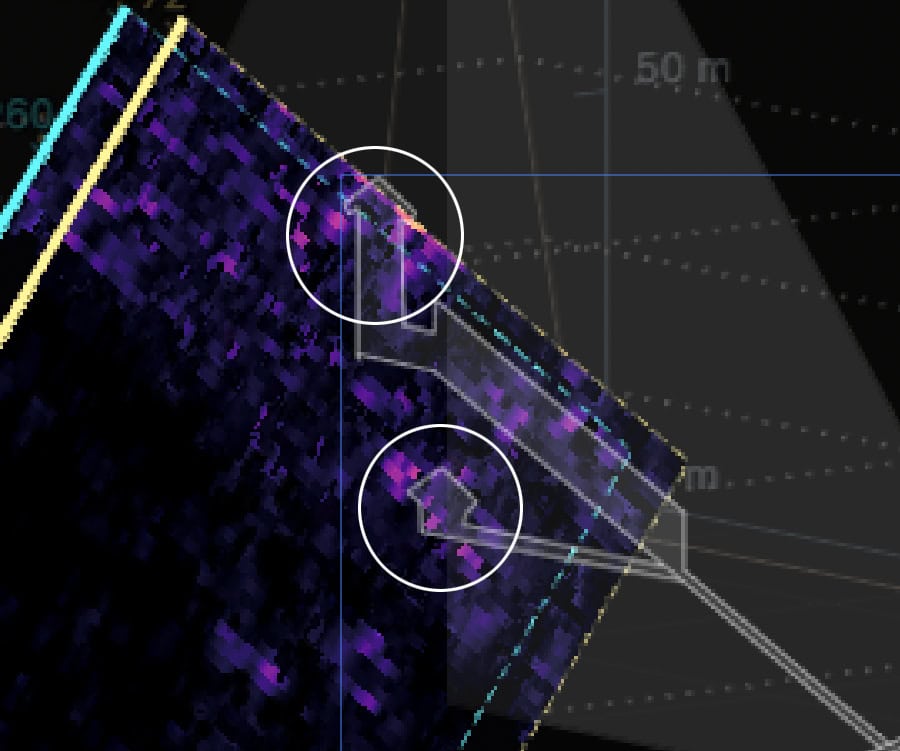
When the two planes are shown intersecting, we can see that the King Queen’s chamber are shown in their accurate locations, at least within the margin of error present in my photoshopping skills. I attempted to place them as accurately as possibly. This is a somewhat rudimentary test in itself, but it is nevertheless succesful in locating the two chambers’s approximate positions.
Filippo had shown in his paper, a more refined scan that even picked up each of the relieving chambers above the King’s Chambers.
While I was not able to find the same exact angle of the Khafre Project model, I did find an approximate one, showing that an additional anomaly picked up on Manu’s scan may actually be showing us the ramp corridor in the model.
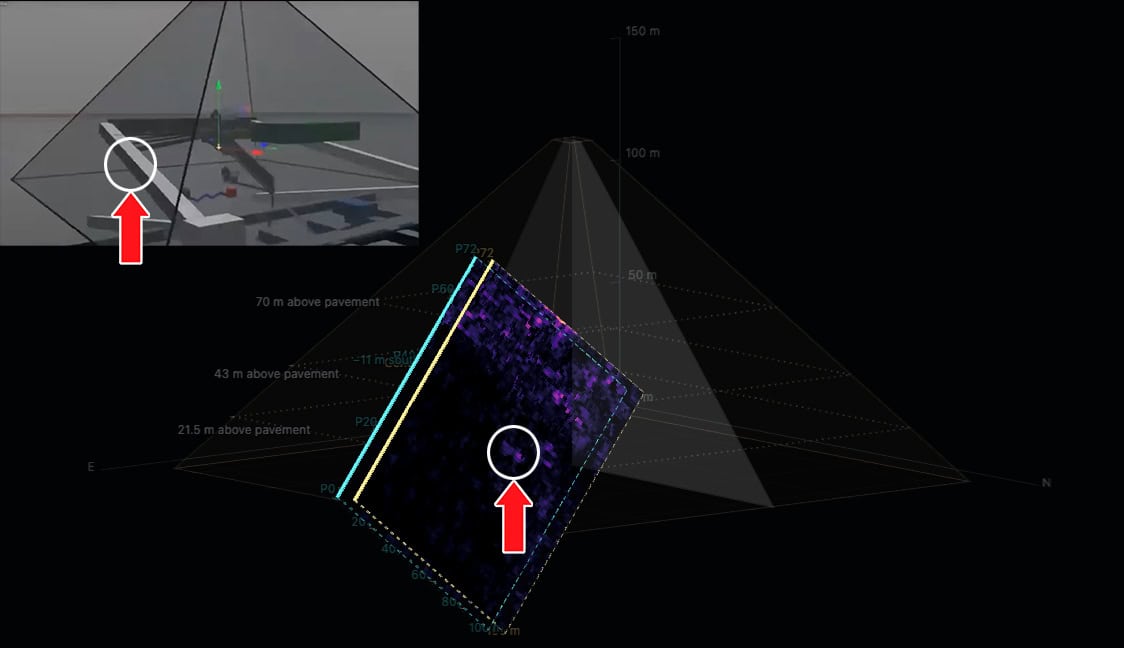
3D Model of Great Pyramid with Scans:
Manu’s experiment on the Great Pyramid is also continuing, so additional results will be published as they become available. In fact, Manu and Filippo stated in our interview that they may even coauthor a paper about these results together. Either way, Manu has indicated that he plans to present the work to the academic community for peer review.
Conclusion:
All the above represents independent validation of the method invented and presented by Dr. Filippo Biondi. This includes proof that:
- SAR data can be used to image subterranean structures at extreme depths
- It can be tested against known remote sensing methods that are trusted in the field
- It can detect and accurately portray known or unknown structures
Therefore, all the discoveries presented by Filippo, Corrado and Manu at Giza, should be given fair treatment by the academic community. The Archaeological Rescue Foundation recommends that the MDPI board of editors review the new evidence presented herein and re-evaluate the decision to retract the paper in question.