ArchaeoSAR Project: Scanning the underground of the world’s most important archaeological sites from space
Trevor Grassi, Frank Rogala
May 2, 2026
In addition to the written report below, the A.R.F. has released an interview introducing the ‘ARCHAEOSAR PROJECT’, with Dr. Filippo Biondi explaining his process and also sharing exclusive details about the Second Sphinx he has already detected at Giza.
Abstract:
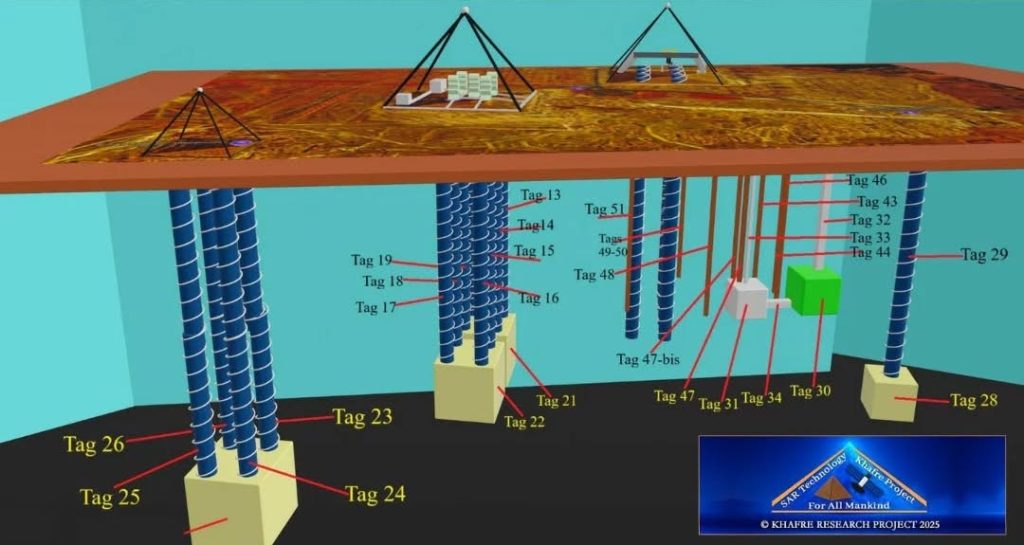
In March 2025, Dr. Filippo Biondi of the Khafre Research Project shocked the world by releasing images of colossal subterranean structures beneath the Giza Plateau. Biondi’s revolutionary innovation on traditional Synthetic Aperture Radar (SAR) Doppler tomography techniques, represents a ‘breakthrough technology’ with applications in archaeology and many other fields. After being recorded by various satellites in orbit, SAR signals can be processed to reveal the shape of voids up to five kilometers below ground, and even detect unique material signatures of other elements including metals, precious minerals, water or oil.
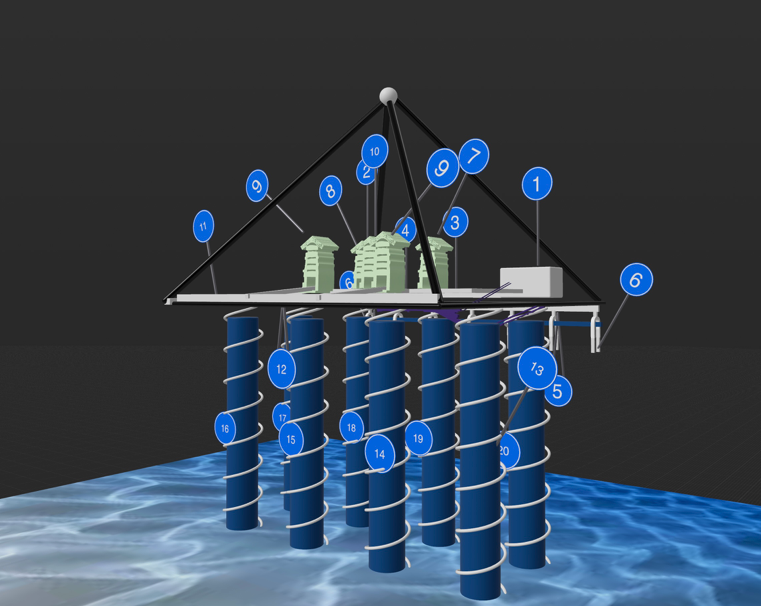
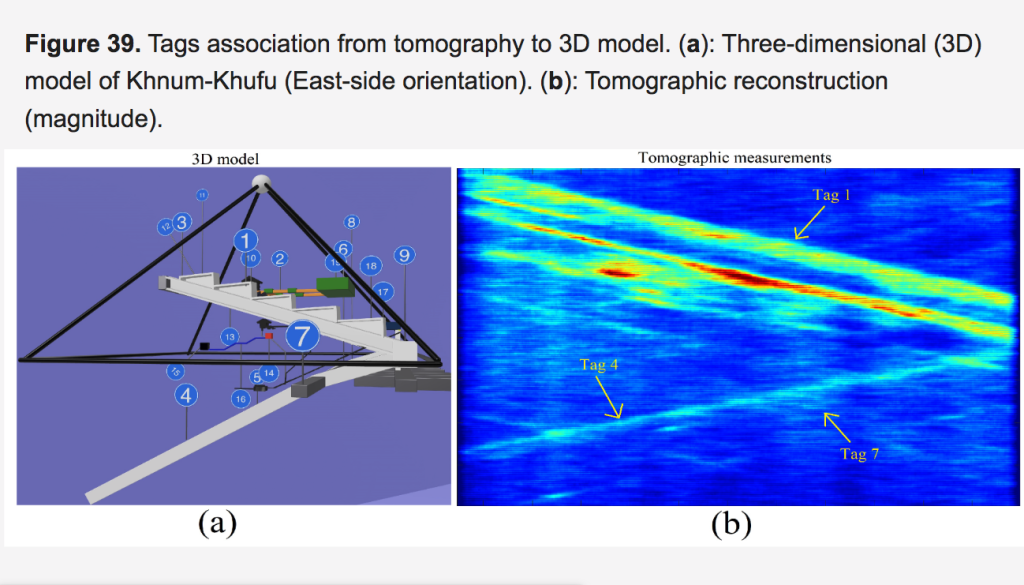
Filippo explained this technology in a 2022 peer reviewed paper, coauthored by Dr. Corrado Malanga, entitled Synthetic Aperture Radar Doppler Tomography Reveals Details of Undiscovered High-Resolution Internal Structure of the Great Pyramid of Giza.
He has also scanned many known structures, including the Gran Sasso physics laboratory, which is 1,400 meters underground, proving that the scans can accurately show the form of voids at such depths. Other companies such as GeoScan Systems and MerlinBurrows have used similar techniques for decades, and their track record of client testimonials prove that it can be done, despite doubts voiced by those who are not familiar with the technology.
Filippo has even shared the software, under a non disclosure agreement, with Dr. Howard Zebker of Stanford University. Zebker, like Biondi, is one of around 200 SAR experts on Earth, as it is a highly specialized field, and he will attempt to replicate the findings of Biondi, to validate the discovery with another qualified perspective.
The technology has been validated in as many ways as possible, and for those still skeptical, I have a full playlist of videos about this subject that lay out the case, many with Filippo himself. You may also consult the resource links at the end of this article.
The ‘MASTER TECHNOLOGY’
The ability to scan for anomalous voids beneath the Earth’s surface, without needing on-site access or posing any risk to archaeological sites, will inevitably lead to the discovery of underground cultural heritage monuments including ‘subterranean cities’, temples, archives, libraries and caches of artifacts from the earliest civilizations of mankind on every continent. The process is cheap, efficient, non-invasive and very insightful, with resolution and material recognition exponentially improving consistently.
When this powerful technology is paired with extensive archaeological research, we have a direct path to the discovery of all the most important ‘Halls of Records’ on Earth. The seed of this idea was planted when Corrado Malanga first convinced Biondi that the best way to put this technology to use ‘For All Mankind’, would be pointing it to the Giza Plateau. The ArchaeoSAR Project aims to grow this concept into a global model. Views from satellite that show us significant chambers can be followed up on the ground with further geophysical examinations and excavations.
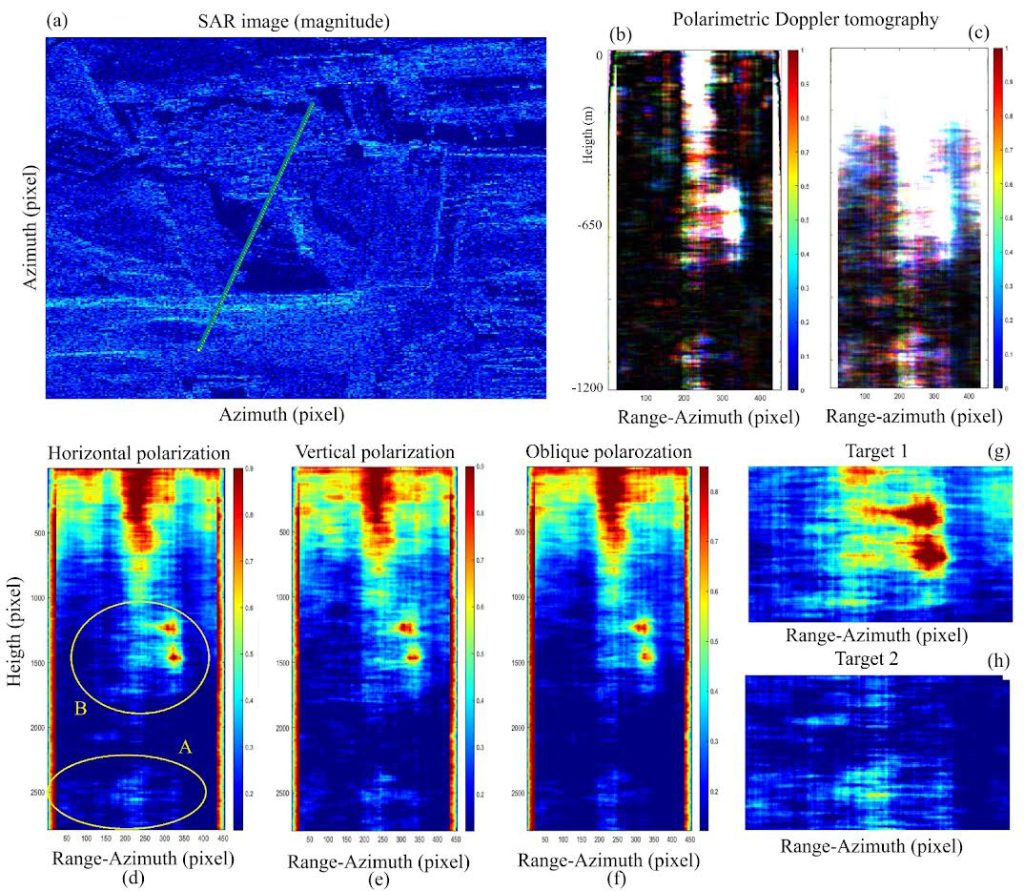
For this reason, the Archaeological Rescue Foundation is working directly with Dr. Filippo Biondi and his foundation, HarmonicSAR, to ensure that he can continue his work scanning archaeological sites like Giza. While he has already agreed to scan the lost labyrinth of Hawara after finishing Giza (projected by Summer 2026), there are countless other sites of promise across the globe, but unfortunately, the process is extremely slow.
The ability to utilize this technology is dependent on processing power. With two powerful computers running 24/7, Filippo was able to process only 200 tomographic images per year, and scanning the Giza Plateau alone is projected to take over two years in itself. Filippo’s software, as his own intellectual property, must remain secure in his own control and so the ‘bottleneck’, limiting the speed at which sites can be scanned, is currently the limitation of processing power.
Our initiative is designed to provide Filippo with more computing power by way of:
- a distributed network, where volunteers online will be able to contribute their idle processing power from home, and the whole world will be able to help reveal the ancient ‘underworlds’.
- Additionally, we can build up his existing computer system to increase capacity.
Both approaches will help contribute to the short and long-term sustainability of the project.
The ‘DIGITAL DIG’
… is a safe, secure, and incredibly simple way to donate your computer’s “spare time” to help process these scans and uncover human history!
How it Works: It’s like SETI@home, but for archaeology! You install a secure, background app (using the trusted BOINC platform, used by scientists for years). When you step away for a coffee, take a break, or go to sleep, the app quietly uses your computer’s idle power to process tiny, anonymous pieces of radar data. When you come back and move your mouse, the app goes to sleep, and your computer is 100% yours again.
The “Digital Dig” app is incredibly secure. It only processes complex numbers—it cannot access your personal files, see your data, or slow down your computer while you’re using it. It costs you nothing, and it requires zero technical knowledge. By lending just a fraction of your computer’s idle power, you become a digital archaeologist. You help protect our global heritage, and you might just help make the greatest discovery of the century—all from your couch.
The Archaeological Rescue Foundation will be responsible for building and maintaining a primary server for the system and maintaining a well researched list of the highest priority archaeological sites that most need to be scanned. This list will take into consideration all input from the public and would prioritize two factors in particular:
1. likelihood of subterranean structures existing there, based on all available information; or the potential yield of significant cultural artifacts and records that can tell us about the earliest civilizations, and
2. the risk factor based on any type of active or potential damage to the site. Sites at greatest risk will be prioritized highest.
When sites are scanned and show significant structures below ground, the Archaeological Rescue Foundation will pursue an on-site investigation and attempt to follow up with ground based remote sensing, as well as excavation, recovery and preservation projects.
By creating a centralized channel for processing power and a central nonprofit for collecting tax deductible donations, we aim to build an ongoing program that will continue to unearth the greatest archaeological treasures of the planet and help to preserve humanity’s most important artifacts that are currently at great risk.
This is the only project of its kind and scope ever to be proposed, and it could operate continuously for the foreseeable future, saving for humanity, countless heritage sites and artifacts that would otherwise be at severe risk of damage or theft!
Filippo’s technology and expertise, combined with the ARF’s archaeological research community, and ability to establish on-site projects, will lead to endless discoveries that will shine a light on the true story of the origins of civilization! It has already begun!
Project Details
Digital Dig is an independent, community-driven computing initiative designed to accelerate analysis of Filippo Biondi’s advanced Synthetic Aperture Radar (SAR) tomography data—technology capable of imaging subsurface structures in three dimensions with unprecedented precision.
The project will establish a private distributed-computing network, allowing verified volunteers to contribute idle processing power (similar to the BOINC model used by SETI@home and Folding@home).
To achieve this, we are seeking startup funding to support:
- Acquisition and configuration of a secure private server
- Installation and optimization of BOINC server/client software
- Hiring a part-time systems engineer for setup and maintenance
- Additional hardware for Filippo
- SAR signal data (some companies offer some of this data for free, but higher resolution imaging must be paid for)
- Outreach, and volunteer client deployment
- Tomographic image analysis and full written reports
- commissioned scans from similar companies for comparative analysis
- Research and administrative costs
If we can raise $100,000, it would cover the initial setup and several years of operation scanning the sites, though establishing on site follow up work at multiple locations around the globe would cost into the millions. Still, the results will be priceless. There is no dollar value that can be placed on knowledge of human origins. If the research can be sustained, if not expanded, we will expect many breakthrough discoveries within the first couple years, and far more in the long term.
This system enables scalable, private, and verifiable computation for Biondi’s archaeological SAR data—while safeguarding his proprietary methods. Conventional computing infrastructure cannot efficiently process the terabytes of SAR data required for 3D subsurface imaging. Commercial cloud platforms are costly and risk intellectual-property exposure.
A private distributed network provides:
- Secure task-slicing and encrypted data handling
- Volunteer participation through lightweight downloadable clients
- Rapid scalability for future sites without exposing core algorithms
The initial deployment will support analysis of scans from the Giza Plateau, Khafre Pyramid, and related geological and engineering studies—including comparative datasets from volcanoes, dams, and underground facilities such as Italy’s Gran Sasso Laboratory.
Objectives
1. Deploy a private computing node dedicated to Biondi’s SAR tomography workflow.
2. Integrate BOINC or equivalent software, customized for encrypted task distribution.
3. Launch the Digital Dig volunteer client, enabling controlled public participation.
4. Maintain full data confidentiality and local custodianship.
5. Deliver a validated proof-of-concept within three months.
Technical Overview
- Server Hardware: 32–64 CPU cores, 256 GB RAM, redundant 50 TB storage
- Software Stack: BOINC + Digital Dig modules for task slicing and 3D reconstruction
- Security: Encrypted data packets, sandboxed processing, access control
- Base configuration can support 250–500 active contributors donating compute time
- Scalable to 2,000+ contributors with additional hardware nodes ($5–8K per expansion)
- If participation exceeds capacity: New volunteers will be queued or redirected to mirror nodes, ensuring stable performance without risking data loss or overload.
Timeline (Three-Month Rollout, if project is funded)
Month 1:
– Purchase/configure private server
– Secure environment setup (firewalls, redundancy, encryption)
– BOINC installation and pilot testing
Month 2:
– Integrate Biondi SAR datasets
– Begin distributed-task slicing and internal simulation runs
– Develop Digital Dig client installer and volunteer portal
Month 3:
– Closed beta with invited users (25–50 contributors)
– Gradual public rollout with up to 250 contributors
– Generate performance report and documentation for funders
Governance and IP Protection
All data and algorithms remain under the custodianship of Filippo Biondi. The server will operate as a private node under restricted access, ensuring that only authorized datasets are distributed. Volunteer clients process encrypted task segments only; no raw or proprietary data is ever exposed. Source code for non-sensitive components will be open for transparency, while core algorithms remain secured.
Expected Outcomes
– Operational private distributed-computing platform supporting archaeological SAR tomography.
– Demonstrated 3D reconstructions of the Giza Plateau and other verified sites.
– Measurable benchmarks for scalability, reliability, and data integrity.
– A reproducible open framework for other scientific or heritage imaging projects.
Following initial setup, modest monthly costs will sustain long-term operation. Future expansions—additional server nodes or mirrored regional hubs—can be supported by incremental grants or partnerships. Each added node increases volunteer capacity by roughly 500 active users, scaling compute power linearly while preserving security.
Digital Dig bridges advanced computational science, archaeology, and citizen participation. By funding or volunteering this initiative, supporters enable a historic first: a distributed computing network devoted to uncovering humanity’s buried past, combining open collaboration with rigorous data protection.
JOIN the DIGITAL DIG
You can take an active role in four ways:
- Make a one time or recurring donation to the Archaeological Rescue Foundation here.
- Share this article on social media, in archaeological groups, or as a comment on videos that are related. Help us reach philanthropists who want to support this important work.
- Once the program is set up, download and run it on your personal computer for free. This page will be updated with the download link once we can raise the funding and build the server.
- Let us know what sites you think should be added to the list. If you believe you know of a site that should be scanned with Filippo’s technology, just let us know all the relevant information at:
info@archaeologicalrescue.org
Resources:
Below are resources for those interesting in learning more about the Khafre Research Project and Filippo Biondi’s technology. You can also watch my ‘Biondi Protocol (Khafre Project) Full Playlist’ here:
2022 Complete technical report on the Great Pyramid SAR scans Malanga, Biondi:
https://www.mdpi.com/2072-4292/14/20/5231
Full Project Abstract, (with text) Corrado Malanga, Filippo Biondi, Armando Mei (PDF):
https://drive.google.com/file/d/1Leaa2tf3OHK31OTmdey_CRa-0vC9-CTD/view?fbclid=IwY2xjawJKqEpleHRuA2FlbQIxMAABHY92RKdFq8dH2_KgnUd7z-PPS_E8-TF49k_hhajr5P0CgjOnkMqOO0FZ3Q_aem_fBgB6bR4V6zPa8aiTFDI-A
Full four hour press conference (with subtitles):
https://www.youtube.com/watch?v=xDpdJFlLpRE
Khafre Project official Facebook account, sharing updates:
https://www.facebook.com/profile.php?id=61574443323296
First English interview with the Khafre Project (Armando Mei and Filippo Biondi with Jay Anderson/Project Unity):
https://www.youtube.com/watch?v=b513P5g7XmQ
Nicole Ciccolo’s Expedition Channel (Official channel representing the Khafre Project):
https://www.youtube.com/channel/UC5sP1DBsBpl8NE1JTIExfHQ
Official email contact for the Khafre Project: ufficiostampa@expedition-nicoleciccolo.com
Manu Seyfzadeh, review/explanation video of their 2022 Great Pyramid Report :
https://www.youtube.com/watch?v=gmYoJV7lZAE
More about Synthetic Aperture Radar scanning:
https://www.capellaspace.com/blog/sar-101-an-introduction-to-synthetic-aperture-radar More about Cappella Space (Satellite company):
https://www.capellaspace.com/
My original post, sharing the project abstract:
https://www.facebook.com/Gizatology/posts/pfbid0HLpUQWUxEcHM3BPsxZChWkboYnWwnSt5tbAjdr8jn9kEL6EsNbVfimLC2md4iwPTl
Higher resolution images:
https://www.facebook.com/Gizatology/posts/pfbid02JFEr7oViG4sMQ7wj7VxvD6aaNMXsLTGjfACNRUjaoGDjxzdY5wfnNxPESa4Nghy7l
Malanga, Biondi, Mei Update March 2:
https://www.youtube.com/watch?v=1VT4Sa8RdMA&t=2s
Malanga, Biondi, Mei Update March 4:
https://www.youtube.com/watch?v=TcEgzicEwHk&t=1s
Corrado Malanga Update, March 16 (second day of press conference):
https://www.youtube.com/watch?v=fnQRD9MO0p0
…
THE SECRET UNDERWORLD OF GIZA (Exclusive revelations of GPR scans at Giza, and MUCH more, William Brown & Trevor Grassi. Playlist with trailer and full episodes):
https://www.youtube.com/watch?v=6aPzy-90qnI&list=PL5YUkAb_nbNTse2hkEDOxIqNbYKq2UAVw
…
References from The Biondi Protocol
Adaptive radar detection in the presence of multiple alternative hypotheses using Kullback-Leibler:
https://ieeexplore.ieee.org/abstract/document/9456044
Perspectives on the Structural Health Monitoring of Bridges by Synthetic Aperture Radar:
https://www.mdpi.com/2072-4292/12/23/3852
Many more of Filippo’s papers are here:
https://scholar.google.com/citations?user=GVyeIgIAAAAJ&hl=en&oi=ao
[Italian only] Corrado Malanga books:
https://www.amazon.com/stores/Corrado-Malanga/author/B0747BDKH5?ref=sr_ntt_srch_lnk_1&qid=1745167352&sr=1-1&isDramIntegrated=true&shoppingPortalEnabled=true&ccs_id=a42952a5-e8ca-498e-8d12-d1888323f6f2
John Anthony West books:
https://www.amazon.com/stores/John-Anthony-West/author/B001H6KXVW?ref=sr_ntt_srch_lnk_1&qid=1745167221&sr=1-1&isDramIntegrated=true&shoppingPortalEnabled=true&ccs_id=8e31163d-444a-4953-ac3c-cfdec4bed30e
Chris Dunn books:
https://www.amazon.com/stores/author/B001K89IS6?ccs_id=cb6fdd16-fd43-4d68-96c1-2fc5db72d8bd
Manu Seyfzadeh’s Edfu Texts Translations: English Translation of an Egyptian Creation Story Recorded at the Temple of Horus in Edfu, Egypt:
https://www.scirp.org/journal/paperinformation?paperid=132416
Video: Egypt’s Underground Cities and Long Range Tunnel System, Kariolis Emil and Trevor Grassi:
https://www.youtube.com/watch?v=Q-UE2VM4wK0&t=16s
ScanPyramids full press conference on the North Face Corridor, March 2, 2023:
https://www.facebook.com/luxortimesmagazine/videos/140764608901112
1968 Report on Muon Scans (Stanford Research Institute, Ministry of Antiquities):
https://www.researchgate.net/profile/Amr-Goneid-2/publication/6097071_Search_for_Hidden_Chambers_in_the_Pyramids/links/0c960538c29516b7df000000/Search-for-Hidden-Chambers-in-the-Pyramids.pdf?_tp=eyJjb250ZXh0Ijp7ImZpcnN0UGFnZSI6InB1YmxpY2F0aW9uIiwicGFnZSI6InB1YmxpY2F0aW9uIn19
Timestamp: Khafre Project addressing the 1968 muon scans in the press conference:
https://youtu.be/bM8vzUUZdVM?t=11721
https://www.capellaspace.com/
https://umbra.space/
Plasma Bubble over the Pyramids (official report) ‘Extremely Long-Range Observations of Ionospheric Irregularities in a Large Longitude Zone From Pacific to Africa Using a Low Latitude Over-The-Horizon Radar in China’:
https://agupubs.onlinelibrary.wiley.com/doi/10.1029/2024GL109579
Study of the water levels at Giza: ‘Shallow geophysical techniques to investigate the groundwater table at the Great Pyramids of Giza, Egypt’:
https://gi.copernicus.org/articles/8/29/2019/
…
First reporters on the Khafre Project
FIRST Video released, after I shared the project abstract, by Liz Metcalfe, Dreams of Atlantis, A Prior World:
https://www.youtube.com/watch?v=vE-BRzn0dDY&fbclid=IwY2xjawJISplleHRuA2FlbQIxMQABHfUlOC5thFSFpW0yQo1zZRzjF-6g9g4OcYLQt19Axuzub_5Y9b7olIuBTA_aem_DioL2RidBpR2rfp95AB-2w
Second Video, Jay Anderson/Project Unity:
https://www.youtube.com/watch?v=zZjU_hioDfQ&t=147s
Third Video, Reese Report:
https://rumble.com/v6qu6bu-sar-scan-of-khafre-pyramid-shows-huge-underground-structures.html?fbclid=IwY2xjawJIS0ZleHRuA2FlbQIxMAABHUtj16oyG2fMwl49z2XhezrfwOB0XQMBoTRmzIoRZOA6IwBP-NbFaRCo5g_aem_zOZ29TxivF6Wn47Vh8Gp4Q
Fourth Video, Jahannah James:
https://www.facebook.com/reel/1063061175660698